
The Last Words of the Love-Sick Time Machine Pilot

And would you ever know if I had
snatched the keys from under the mat,
and unlocked the nucleus of our parents’ old Astra
with its quarks of petrol and spent Silk Cut packs

and taken my younger self for a spin
past the shutters lit blue from within –
the freezer light of Kennedy’s fishmonger’s
not Frankenstein’s lab after all – sorry,

and told you, Donny, this one’s important:
do what you were going to do and ask Susie Whitlow
on a date— yes, like last Wednesday when you tried
at Latchmere slides, feeling doubly sick from the height 

and your nerves on the ladder to the diving board –
I shouldn’t remind you – but in ten years’ time,
over a bottle of wine, she’ll tell you she’s got
a new boyfriend, whose name, you joke, sounds

like a make of saucepan, which isn’t so funny
for you, so much as a blow but sometimes
a little hurt is worth a heartful – like baking
with Dad while nursing a broken foot

from that casserole dish you failed to lift,
and don’t leave for Dover without matches,
and put a couple more quid on Little Polveir
at the Grand National this year, but still  

slip the winnings into the lining of Mum’s Dorla purse
like you were planning and when pulling up home again
I say, this is my last visit, I’m restoring the timeline,
so you should go and tip-toe inside and pause for a beat  

on the third stair, and when the past’s within walking distance
try not to startle all three of your selves on the landing,
or you’ll wake everyone up and we won’t make it,
and Mum wants answers and Dad gets sick 

and don’t recall our talk to anyone,
over time it will blur, and merge;
let’s call me the best of a good conscience
and say these things, and only these things

meaning when you test the Tipler core in Culham
after the press conference, you keep curious,
stride into the temporal displacement unit,
feeling in your atoms you might never know?


by Harry Man

This is the second of a special trio of poems being posted this week by writers who are featuring in one of the two Poetry Centre events in the upcoming Oxford Literary Festival. Harry Man will be reading alongside Sarah Hesketh and Claire Trévien on Tuesday 5 April at 4pm, whilst Helen Mort and Alan Buckley will be performing their poetry show ‘The Body Beautiful’ on Sunday 3 April at 2pm. We hope to see you there!

‘The Last Words of the Love-Sick Time Machine Pilot’ is copyright © Harry Man, 2013. It is reprinted from Lift (Tall Lighthouse, 2013).

Harry Man was born in Buckinghamshire in 1982. He won the 2014 Struga Poetry Evenings UNESCO Bridges of Struga Award, and his pamphlet, Lift, was shortlisted for the ‘Best Pamphlet’ in the 2014 Saboteur Awards. Harry has taught Creative Writing workshops in a wide-range of settings. His poetry has appeared in many publications, including New Welsh ReviewFuselitPoems in the Waiting RoomAnd Other Poems, as well as in Anthologies such as Coin Opera 2 and Rewiring History.

Harry has collaborated with the dancer & choreographer Jennifer Essex on a production for the London College of Fashion, with Kirsten Irving for ‘Auld Enemies’ curated by SJ Fowler, and with illustrator Sophie Gainsley on Finders Keepers, which examines Britain’s disappearing wildlife. Harry also narrates children’s books for HarperAudio and was selected to be the voice of many of Michael Morpurgo’s children’s books. In 2016, Harry was Poet-in-Residence at the StAnza Poetry Festival. Harry Man’s first pamphlet of poems, Lift (2013) is published by Tall Lighthouse in English and by Struga Poetry Evenings in Macedonian. You can read more about Harry on his website, more about Lift on the Tall Lighthouse site, and follow Harry on Twitter.

Tall Lighthouse is an independent publishing house in the UK, established in 1999 by Les Robinson. It publishes full collections of poetry as well as pamphlets, and has featured work by Maurice Riordan, Hugo Williams, Daljit Nagra, Helen Mort, Roddy Lumsden, and Sarah Howe, amongst others. The press has established itself as a leading light on the small press poetry scene, and its pamphlet publications have received the Poetry Book Society‘s Pamphlet Choice Award on a number of occasions. The current Director and Editor of the press is Gareth Lewis, who took over after Les Robinson stepped down from those roles in 2011. You can read more about the publisher on its website.

Copyright information: please note that the copyrights of all the poems displayed on the website and sent out on the mailing list are held by the respective authors, translators or estates, and no work should be reproduced without first gaining permission from the individual publishers.
This Place

When my time comes
and I ask you
again and again where I am
you’ll be able to tell me, truthfully
that this place is a train
that I know quite well

            Calling at:
Warrington Bank Quay
Wigan Northwestern
Preston

            Calling at:
Wigan Northwestern
Warrington Bank Quay
and London Euston, where this journey terminates

            Calling at:


by Sarah Hesketh

This is the first of a special trio of poems to be posted on the list over the next week from poets who are featuring in one of the two Poetry Centre events in the upcoming Oxford Literary Festival. Sarah Hesketh will be reading alongside Harry Man and Claire Trévien on Tuesday 5 April at 4pm (there are more details on the Oxford Literary Festival website), whilst Helen Mort and Alan Buckley will be performing their poetry show ‘The Body Beautiful’ on Sunday 3 April at 2pm; more details on the OLF website. We hope to see you there!

‘This Place’ is copyright © Sarah Hesketh, 2014. It is reprinted from The Hard Word Box (Penned in the Margins, 2014) by permission of Penned in the Margins.

In 2013 poet Sarah Hesketh spent 20 weeks visiting a residential care home for people with dementia. The result is The Hard Word Box, a book of poems and verbatim interviews that takes the reader on a surprising and enriching journey through memory and imagination.

The agility of Hesketh’s poetic voice channels moments of tenderness, suffering and humour, revealing dementia as a negotiation with language and silence. The Hard Word Box is an inventive and compassionate meditation on the things that will be lost. Read more about – and further samples from – the book on the Penned in the Margins website.

Sarah Hesketh obtained an MA in creative writing from UEA. Her first full collection of poetry, Napoleon’s Travelling Bookshelf, was highly commended in the Forward Prize 2010. In 2013 she was poet-in-residence with Age Concern, working with elderly people with dementia, and in 2014 she published The Hard Word Box, a collection of poems and interviews inspired by this experience. In 2015, she was commissioned by the Holocaust Memorial Day Trust to produce ‘Grains of Light’, a sequence of poems based around the story of Holocaust survivor Eve Kugler. You can read more about Sarah’s work on her website.

Penned in the Margins creates publications and performances for people who are not afraid to take risks. The company believes in the power of language to challenge how we think, test new ideas and explore alternative stories. It operates across the arts, collaborating with writers, artists and creative partners using new platforms and technologies. Read more about its work on its website. You can also follow Penned in the Margins on Twitter and on Facebook.

Copyright information: please note that the copyrights of all the poems displayed on the website and sent out on the mailing list are held by the respective authors, translators or estates, and no work should be reproduced without first gaining permission from the individual publishers.

The Muntjac

reflects our headlights in his eyes;

his scrubby body disappears into the hedge

now white with May,

tar and fern on his delicate hooves

and all at once the road reverts

to emptiness, but something of his presence

stays, an apparition on the verge:

fugitive from walled estates that favoured

curiosities, alien tropics quick and rank,
snaking beyond the boundaries, laying roots.

The road curves past Darks Dale floodlit,

a tractor ploughing furrows, past New Broke Ups,

Wrong Land; and beyond, a tangle of forest,
oaks hunched like old men against the night.


by Tamar Yoseloff   

News from the Centre! Tonight at 7pm, the Poetry Centre hosts an exciting poetry reading at the Albion Beatnik in Oxford with visiting US poet Leah Umansky and local poet Penny Boxall. Leah is the author of the dystopian-themed chapbook, Straight Away the Emptied World, the Mad-Men inspired, Don Dreams and I Dream, and the full-length collection Domestic Uncertainties. Penny is Education Officer at Oxford’s University Church. Her debut collection, Ship of the Line, was published by Eyewear in 2014, a year in which she also won second prize in the Jane Martin Poetry Prize and had her poem, ‘What You Mean to Me’, commended in the Forward Prize. For more details of the reading, visit our Facebook event page.

Irish literature expert (and former Director of the Poetry Centre) Dr Eóin Flannery, and Dr Donal Lowry, who has published widely on Irish foreign policy, are leading a one-day short course on Saturday 14 May at Oxford Brookes: ‘One Hundred Years On: 1916–2016. The Easter Rising: its History and Literature, Then and Now’. For more details, visit the Brookes website.

‘The Muntjac’ is copyright © Tamar Yoseloff, 2015. It is reprinted from A Formula for Night: New and Selected Poems (Seren, 2015) by permission of Seren Books.

Tamar Yoseloff’s A Formula for Night: New and Selected Poems includes dazzling new work as well as selections from her print collections and pieces from collaborations with artists. The title poem was commissioned by the Hayward Gallery for their 2013 exhibition ‘Light Show’ and is based on an installation by the Welsh Artist Cerith Wyn Evans. The poems in this collection are also concerned with heavenly presences, as well as evil spirits, explorations of light and dark.

Writing about the book, Martyn Crucefix has commented: ‘A Formula for Night is a major collection and career summary and really ought to be both on your wish list and on prize shortlists in the coming 12 months.’ Read more about A Formula for Night on Seren’s website.

Tamar Yoseloff is the author of four poetry collections, including Sweetheart, a PBS Special Commendation and the winner of the Jerwood Aldeburgh Festival Prize. Her most recent collections are The City with Horns and Formerly, a chapbook incorporating photographs by Vici MacDonald, which was shortlisted for the Ted Hughes Award. As well as other projects with artists, Yoseloff has also edited A Room to Live In: A Kettle’s Yard Anthology. She has been Reviews Editor for Poetry London and Poetry Editor for Art World. Yoseloff lives in London, where she is a freelance tutor in creative writing.  She explores the intersection between poetry and visual art on her blog Invective Against Swans.

Seren is an independent publisher based in Wales. Founded in 1981 to publish poetry discovered by the then-editor of Poetry Wales magazine, Cary Archard. Under Managing Editor Mick Felton the press now publishes a broad range of fiction, non-fiction, and criticism. Amy Wack has been Poetry Editor at Seren for over 20 years. During that time, poets published by Seren have won or been shortlisted for the Costa, Forward, T.S. Eliot and Aldeburgh Prizes. ‪You can find out more about Seren on the publisher’s website.

Copyright information: please note that the copyrights of all the poems displayed on the website and sent out on the mailing list are held by the respective authors, translators or estates, and no work should be reproduced without first gaining permission from the individual publishers.

Blackberries

It’s dark by nine, stoats have been seen
on the dry stone wall by the sun-room,
and I have a feeling the blackberries need to be picked.When I set off with my grandmother’s hat, her stick and basket,
children run after me, thistles lie down,
the cows make way at the gateand even the insects seem to disperse
more respectfully, leaving their eggs
in the crop’s black best as if that might stop me


simmering the lot of them tomorrow
in the big aluminium pan. Somewhere in an outbuilding
jars of ten-year-old overboiled jam

recrystallise slowly (I should throw them away)
while the good stuff sits on a shelf in London
where no one has time for toast and tea.

No one else will put up with so many scratches,
wade into rosebay willowherb six foot high
or chance it with the stinging nettles,

bitten and burnt and aching all over,
filling the basket with little black blind spots,
berry-sized bruises that float in the eye.

This summer again, in patches of scrub
at the back of my mind, such fruit has been ripening
red from green and green from white

that somebody has to pick it, some sweet thing
of the sweetness of August’s August rain
be preserved.


by Kate Bingham

Join us on Monday 21 March for an exciting poetry reading at the Albion Beatnik in Oxford with visiting US poet Leah Umansky and local poet Penny Boxall. Leah is the author of the dystopian-themed chapbook, Straight Away the Emptied World¸ the Mad-Men inspired, Don Dreams and I Dream, and the full-length collection Domestic Uncertainties. Penny is Education Officer at Oxford’s University Church. Her debut collection, Ship of the Line, was published by Eyewear in 2014, a year in which she also won second prize in the Jane Martin Poetry Prize and had her poem, ‘What You Mean to Me’, commended in the Forward Prize. For more details, visit our Facebook event page.   

‘Blackberries’ is copyright © Kate Bingham, 2015. It is reprinted from Infragreen (Seren, 2015) by permission of Seren Books.

Kate Bingham’s Infragreen is her eagerly-awaited third collection of poems. Her subject matter can be deceptively simple: rain, the school run, a conversation, but these poems are full of subtle emotional power and wrought with dazzling patterns. Quicksand Beach, her Forward Prize-nominated previous book, was admired by The Guardian for its ‘urgent interrogation of the ways in which we love.’

According to Poetry Review, ‘Nothing is taken for granted in the intellectual universe of these poems: instead they draw strength from going on creating in the face of mystery… Infragreen is full of sensuous, imaginative and beautifully accomplished work.’ Read more about the book on the Seren website.

Kate Bingham is a poet, novelist, and filmmaker who lives in London. Her previous collections are Cohabitation and Quicksand Beach. ‘On Highgate Hill’ was nominated for the Forward Prize Best Single Poem in 2010. Find out more about Kate’s work on her website.

Seren is an independent publisher based in Wales. Founded in 1981 to publish poetry discovered by the then-editor of Poetry Wales magazine, Cary Archard. Under Managing Editor Mick Felton the press now publishes a broad range of fiction, non-fiction, and criticism. Amy Wack has been Poetry Editor at Seren for over 20 years. During that time, poets published by Seren have won or been shortlisted for the Costa, Forward, T.S. Eliot and Aldeburgh Prizes. ‪You can find out more about Seren on the publisher’s website

Copyright information: please note that the copyrights of all the poems displayed on the website and sent out on the mailing list are held by the respective authors, translators or estates, and no work should be reproduced without first gaining permission from the individual publishers.

Parapluie

For P & ZG)

I do not want to be made of blue velvet;
I want to be blue velvet. With a handle of silver
shot lace, made by a consumptive old
Romanov who sips her remittance from tall
thin glasses of sweetened black tea.

It is an understatement to say I wish
to shimmer; that I’m quietly reflective
of colour. Selective colour.
I do not want to reflect grey.

I want to be crafted with unprecedented
patience by a slender man who has no
English and fabulous hands. I want to stand
alone, without the icy compromise of a solitary
walk in St Petersburg. I want to lie; 

lie beautifully within the fabrication
of my fabric. I want to spread, not just my folds
but myself, on the edge of a shelf of mahogany or
a complex inlay of cherry.

I will be complete but not
undone by a ribbon of magenta. I will be warmed
by dry fired irons and the only creases that fall
from me will be creases that are not
part of the truest part of me.

I will be held by a thin frame of teak, picked
from a clearing in Burma. It has been
rosined with cinnamon and dipped in a resin
of smoked cane sugar.

I will hear the wind before it blows through
the gap in a sash window of a fifth floor
rent-controlled apartment on the west side
of Wenceslas Square. I will contemplate only
the nature of rain.

If I am left in the maze of second hand shops
that runs under Rue de Rivoli; if I’m thrown on a bonfire
at the end of no particular week, my combustion
will form a distraction of radiance.
I will show you the origin of red.

by Rosie Shepperd

Tomorrow at the Old Fire Station in Oxford, poet & theatre-maker Hannah Silva presents her solo show ‪‎Schlock! Produced by Penned in the Margins Schlock! sees Hannah rip up her copy of Fifty Shades of Grey and with the help of radical punk-pirate Kathy Acker, she attempts to put the female body back together.You can find out more on the OFS website .

The Poetry Centre has programmed two events at the upcoming Oxford Literary Festival . Helen Mort and Alan Buckley perform their show ‘The Body Beautiful’ on Sunday 3 April , and then Claire Trévien, Harry Man, and Sarah Hesketh will read on Tuesday 5 April . Come along!

‘Parapluie’ is copyright © Rosie Shepperd, 2015. It is reprinted from The Man at the Corner Table (Seren, 2015) by permission of Seren Books.

Rosie Shepperd’s debut poetry collection, The Man at the Corner Table , is a feast of delights. Its grace and precision charm us, and then beguile us into a world that is vital and unsettling. Sheenagh Pugh says: ‘Rosie Shepperd looks aslant at the everyday until it becomes uncommon. She explores sadness through humour and emotion via the silence of white space. Her voice is singular, engaging, unmistakable.’

Rosie Shepperd trained as an economist and worked in financial journalism and then banking in London and New York until 2004. She studied Creative Writing at London University’s Birkbeck College and at the University of South Wales and has a PhD from London University’s Goldsmith’s College. Her poems have appeared widely in journals and she has won a number of competitions and was shortlisted for the 2013 Forward Prize for Best Single Poem, which was read on stage by Juliet Stevenson. Stevenson observed: ‘Rosie Shepperd’s poems read like miniature films. The intensity of the moment she captures in each is framed with such vivid imagery, shot through with sensuality and wit. And her rhythms have the rigour and restlessness of really good jazz… Hers is a startlingly original voice. I so enjoyed reading this collection.’

Seren is an independent publisher based in Wales. Founded in 1981 to publish poetry discovered by the then-editor of Poetry Wales magazine, Cary Archard. Under Managing Editor Mick Felton the press now publishes a broad range of fiction, non-fiction, and criticism. Amy Wack has been Poetry Editor at Seren for over 20 years. During that time, poets published by Seren have won or been shortlisted for the Costa, Forward, T.S. Eliot and Aldeburgh Prizes. ‪You can find out more about Seren on the publisher’s website.

Copyright information: please note that the copyrights of all the poems displayed on the website and sent out on the mailing list are held by the respective authors, translators or estates, and no work should be reproduced without first gaining permission from the individual publishers.

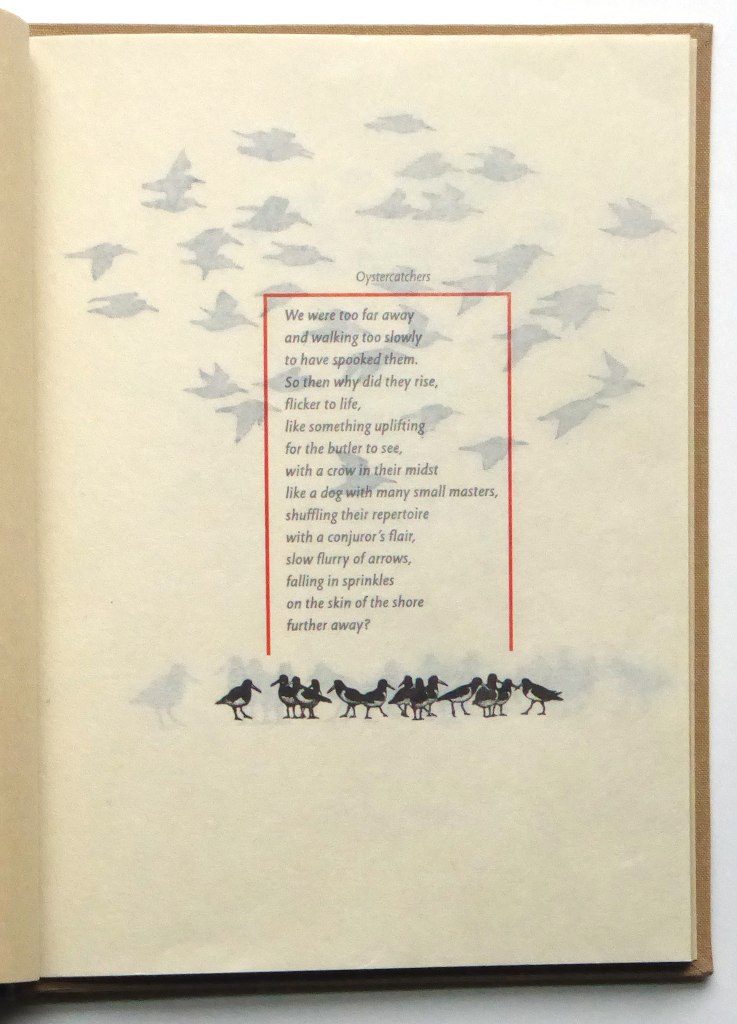
Oystercatchers

We were too far away
and walking too slowly
to have spooked them.
So then why did they rise,
flicker to life,
like something uplifting
for the butler to see,
with a crow in their midst
like a small dog with many small masters,
shuffling their repertoire
with a conjuror’s flair,
slow flurry of arrows,
falling in sprinkles
on the skin of the shore
further away?

And then why rise again,
and then handbrake turn
not screeching like swifts,
to swirl their way back
to return to exactly
the point where they started.
To settle again,
piping down, down, down?
Why else but the sheer
species élan
of being alive?


by Phil Madden, with illustrations by Paul L. Kershaw

‘Oystercatchers’ is copyright © Phil Madden, 2015, and the illustrations are copyright © Paul L. Kershaw. It is reprinted from The Amphibious Place (Grapho Editions, 2015) by permission of Grapho Editions.

Phil Madden has worked with Paul Kershaw on two other limited-edition works: Wings Take Us (2009) and Paths (2013). Both are published by Grapho Editions. He has also produced limited-edition works with the engraver Peter Lazarov: The Urban Moon (2009) and The Puppeteer and the Puppet (2012), published by Pepel Press. Phil has had exhibitions of concrete poetry in Brussels and the UK and won the Cinnamon Press Concrete Poetry Competition in 2012. The Tea Way (Gean Tree Press) was published electronically in 2012.

After many years as a printmaker specialising in wood engraving, during which time he has become recognised as one of the country’s leading wood engravers, Paul Kershaw has extended his interests towards the design, printing and publishing of handmade books in small editions. The three books created in collaboration with Phil Madden have been printed using hand presses, on fine-quality paper and display a variety of graphic techniques to find new ways of combining text and image. Paths received a Judges’ Choice Award at the 2013 Fine Press International Book Fair in Oxford. The Amphibious Place was also chosen for this award in the 2015 Book Fair, as well as receiving the Toby English Prize for the most original book.

The Amphibious Place (215 x 175mm, 20pp, published by Grapho Editions, October 2015; price: £125, plus postage & packing). The book is printed on Atsukuchi and Kozuke paper, using an Albion handpress and a cylinder press. There are 60 copies in the edition. The setting is Magma. It is cloth bound with a stab binding and housed in a matching slipcase. This book has as its theme the seashore, the space shared by sea and land. Both text and image are centred horizontally along a single line, and the in/out cycle of the tides has inspired various structural pairings and dualities. The binding style, which doesn’t allow the book to lie open, is in part intended to suggest restless motion.

Phil Madden’s poem ‘Oystercatchers’ is divided between two pages, a recto and the following verso, using one sheet of thin paper folded at the fore edge. The inner face has been printed as well as the outer one so that is possible to see through the paper to the layers underneath. To learn more about the book and see further pages from it, visit Paul Kershaw’s website.

You can also get in touch with Paul via e-mail: plkershaw@mac.com

Copyright information: please note that the copyrights of all the poems displayed on the website and sent out on the mailing list are held by the respective authors, translators or estates, and no work should be reproduced without first gaining permission from the individual publishers.

In That Year

And in that year my body was a pillar of smoke
and even his hands could not hold me.

And in that year my mind was an empty table
and he laid his thoughts down like dishes of plenty.

And in that year my heart was the old monument,
the folly, and no use could be found for it.

And in that year my tongue spoke the language
of insects and not even my father knew me.

And in that year I waited for the horses
but they only shifted their feet in the darkness.

And in that year I imagined a vain thing;
I believed that the world would come for me. 

And in that year I gave up on all the things
I was promised and left myself to sadness. 

And then that year lay down like a path
and I walked it, I walked it, I walk it.  


by Kim Moore

News from the Centre: the Poetry Centre’s International Poetry Competition awards event took place last Friday. If you couldn’t make it, you can watch the ceremony (and hear readings from the winning poets, local poets, and by Hannah Lowe) on the Brookes website . The event begins about 14.30 into the film.

Dr Niall Munro, Director of the Centre, appeared with Prof Langdon Hammer on the Dan Schneider Video Series to discuss American poet Hart Crane recently. You can watch the discussion via YouTube .

‘In That Year’ is copyright © Kim Moore, 2015. It is reprinted from The Art of Falling (Seren, 2015) by permission of Seren Books.

The Art of Falling is Kim Moore’s keenly-anticipated debut poetry collection. A young poet from Cumbria, she writes with a compelling directness and power, as inspired by her life as a music teacher, as she is by the lives of ‘my people’ ancestors, poets and musicians. A case of domestic violence features in the cathartic central section. ‘In That Year’ is the opening poem of that section and was nominated for the Forward Prize for Best Poem of 2015. 

Poetry London has commented that ‘there is a real menace and a compelling sense of the narrator’s urgent struggle to escape her abuser in this sequence, with the cycling back of repeated words reflecting the circular non-logic of a woman trapped in a violent relationship.’

Kim Moore lives in Barrow, Cumbria. Her poems have been published in the TLSPoetry ReviewPoetry London, and elsewhere. She regularly appears at festivals and events, and her prize-winning pamphlet, If we could speak like wolves (Smith-Doorstop), was chosen as an Independent Book of the Year in 2012 and was shortlisted for other prizes. Moore won an Eric Gregory Award in 2011 and the Geoffrey Dearmer Prize in 2010. You can read more about her book on the Seren website, and more about Moore’s work on her own site. You can also follow her on Twitter.

Seren is an independent publisher based in Wales. Founded in 1981 to publish poetry discovered by the then-editor of Poetry Wales magazine, Cary Archard. Under Managing Editor Mick Felton the press now publishes a broad range of fiction, non-fiction, and criticism. Amy Wack has been Poetry Editor at Seren for over 20 years. During that time, poets published by Seren have won or been shortlisted for the Costa, Forward, T.S. Eliot and Aldeburgh Prizes. ‪You can find out more about Seren on the publisher’s website

Copyright information: please note that the copyrights of all the poems displayed on the website and sent out on the mailing list are held by the respective authors, translators or estates, and no work should be reproduced without first gaining permission from the individual publishers.

Studio Flat

Socks hang like bats from a skylight.
They may be dry in time for the moon.
The camp site owner’s water-feature
drains more blood from the sun.

Cars queue for the narrow bridge.
Birds catch their pulses and fly.

I am suddenly old. What’s an attic
but a bungalow in the sky.

And where are you, my sons?

I heard your voices in the bells

of snowdrops pulled by the wind.
These tulips have lost their smell.

Perhaps I could tell you, one day

where the snowdrops went, why old men
dry their socks on the moon, and what
darkened the skylight, just then.

by Paul Henry

This Friday from 6-8pm in the John Henry Brookes Lecture Theatre, the Poetry Centre presents its inaugural International Poetry Competition awards event, which will include readings by the winners and by the judge, Hannah Lowe. More details can be found on the Centre’s website.  All are welcome, but RSVP asap please to poetrycomp@brookes.ac.uk

‘Studio Flat’ is copyright © Paul Henry, 2015. It is reprinted from Boy Running (Seren, 2015) by permission of Seren Books.

Boy Running is the artful new collection of poems by Paul Henry and the first to follow his widely praised: The Brittle Sea: New and Selected Poems. Also a singer-songwriter Henry is known for his precise lyricism, intimate tone and a cast of characters inspired (like Dylan Thomas) by his childhood by the sea in Aberystwyth, West Wales. Commenting on Henry’s work, Hugo Williams has written: ‘With the purity of a sixteenth-century poet, Paul Henry lets fall his beautiful lyrics like cloaks in the mud of every day. Effortless epiphanies and images gradually break open, releasing a strange power, a dark ocean of longing and loss. His poetry deepens our perception of the world.’ Read more about Boy Running on Seren’s site, and more about Henry on his own website.

Paul Henry came to poetry through songwriting. He has read and performed his work at literary festivals across Europe, Asia and the USA. A popular Creative Writing tutor, Henry has lectured at the University of South Wales and led courses at writers’ centres in the UK and France. Also a broadcaster, Paul Henry has written and presented arts programmes for BBC Radio Wales, Radio 3 and Radio 4.

Seren is an independent publisher based in Wales. Founded in 1981 to publish poetry discovered by the then-editor of Poetry Wales magazine, Cary Archard. Under Managing Editor Mick Felton the press now publishes a broad range of fiction, non-fiction, and criticism. Amy Wack has been Poetry Editor at Seren for over 20 years. During that time, poets published by Seren have won or been shortlisted for the Costa, Forward, T.S. Eliot and Aldeburgh Prizes. ‪You can find out more about Seren on the publisher’s website.

Copyright information: please note that the copyrights of all the poems displayed on the website and sent out on the mailing list are held by the respective authors, translators or estates, and no work should be reproduced without first gaining permission from the individual publishers.

Historia


                   moving on or going back to where you came from


                                               Amy Clampitt


                   it is not the substance of a man’s fault

                   it is the shape of it

                   is what lives with him, is what shows


                                               Charles Olson


a room crammed with sharp toys                              


a field zesty with fire   


                   history as historia        


        cool as a shot to the mouth    


                            *


                                      in pinched shoes  

                                               cataleptic            


                            merely to show up


                   the birdlime viscidity of the garden

                   the scalpel-like finger

                              of a shriveled leaf—                     


                   not accusatory   

                                               shadowed only

                                                         by itself

                   not pointing

         towards a balance-act 

                                             but balancing         


                            *


I was six and made of violins

                                               stumped

                            by metronomic light 


I wanted to energise him away

         like glucose

                   globed

         into whiteness—


         a voice spoken slantwise

                            but faraway—    


                                      sleeping it off


                   I traveled in the dark

                   so as not to be seen    


                            *


         dusk-nervousness

         in what is             unclaimed


I wait and fail      

         paying off warders

                   at your door—    


                                               the thrillbox

                                               of birthdays


                   whalecalls from waterclotted

                            condensation


                                      the gazebladed kitchen 


                   the uplander silences of television


                                      blackish fingernails

                                                         from window-mould


                            eyes goggled

                                      towards a lit hearth 

                                               fringe fraying


                            or cupping at the curtain frame

                                      fearful of fire 

                                               on the domestic zodiac


bees cried in their flower-coats

                   collecting honey


                            *


                   how the air divides      

                            like cutting a loaf—


         as much childed           

                   as fevered


                                      left alone

                            in the dry season         


         to feed from the day’s nutrients—


                                                                  naphtha mirage 

                                                                            over the wheatfield

                                                                                              at sunset


                                               foxfur grinning on a spidersweb


                                                                  dialysis of rain

                                                                            inside a garden well     


                                                                  equal to breath             


                            *


         —to hear the substance of the earth

                                      to know its shape        


                   blessèd as an egg

   and yet—


                   and yet bombarded

                            by the radio impulse

                                      of survival


                   the whistlework of money—


her ivied hair       

                   trenched at the oven or

         admonished at the fire-grate


                            *


shuffle-worn cards

                                      blanked-out letters

                                               from the on-dead 


how life tickles the palm         at twenty


                            *


                   dreaming up worser devils


thinking the lesser disease might be

                                               loneliness—


no-one to ignite

                   the red-eyed bird

                            of your mind


no-one told you why

                                        love

                                               blunts


                            *


if the bones sing          


if chaos is chaos         

         returned—          


                                               no atom nuclei

                   no definitive cure         


*


enter fortune


         a ransacked house   

                   half-emptied—   


that which remains

preserved in boxes


                   now bulges

         like a museum   


                            *


baffled voices     vow trounces

         —as if from any archive—


I lean over and touch my ear

         to the grid complex—


                            like hearing ritual cannibalism

                                      in the byways of a river


by James Byrne

Please join us on Friday 19 February from 6-8pm here at Oxford Brookesto celebrate the prize-winning poets of the ‘Open’ and ‘English as a Second Language’categories in our inaugural International Poetry Competition. The event willinclude readings from the winners, as well as an exciting showcase of work fromlocal young poets, mentored by award-winning writer, Kate Clanchy. Lightrefreshments will follow. If you would like to attend, please let us know viae-mail: poetrycomp@brookes.ac.ukby 10 February. 

‘Historia’ is copyright © James Byrne, 2015. It is reprinted from White Coins (Arc Publications, 2015) by permission of Arc Publications.

James Byrne’s most recent poetry collection Blood/Sugar, was published by Arc Publications in 2009. Byrne is the editor of The Wolf, an internationally-renowned poetry magazine, which he co-founded in 2002. He won the Treci Trg poetry festival prize in Serbia and his Selected Poems: The Vanishing House was published in Belgrade. Byrne lives in Liverpool and is a Lecturer in Creative Writing at Edge Hill University. His poems have been translated into several languages including Arabic, Burmese and Chinese and he is the International Editor for Arc Publications.

White Coins rewards the reader with a nomadic poetry for the 21st century; one that mingles personal, social and historical spaces whilst celebrating, at all times, linguistic versatility and innovation. Read more about the book on Arc’s website, and hear James read from his work on the Archive of the Now site.

Since it was founded in 1969, Arc Publications has adhered to its fundamental principles – to introduce the best of new talent to a UK readership, including voices from overseas that would otherwise remain unheard in this country, and to remain at the cutting edge of contemporary poetry. Arc also has a music imprint, Arc Music, for the publication of books about music and musicians. As well as its page on Facebook, you can find Arc on Twitter. Visit Arc’s website to join the publisher’s mailing list, and to find full details of all publications and writers. Arc offers a 10% discount on all books purchased from the website (except Collectors’ Corner titles). Postage and packing is free within the UK.

Copyright information: please note that the copyrights of all the poems displayed on the website and sent out on the mailing list are held by the respective authors, translators or estates, and no work should be reproduced without first gaining permission from the individual publishers.

Tercets on love—The lovers


See how those cranes fly arcing through the sky!
The clouds they have for company on their way
Were there already when they had to fly

From one life to another far away.
Together at the selfsame height and pace
It seems an almost casual display.

That crane and cloud just chance to share the space
Of the wide skies through which they pass so briefly
So neither one may linger in this place

And all they see is one another slightly
Rocking on the wind in loose accord
Who now in flight lie side by side so lightly

The wind may carry them off into the void.
If they remain themselves, and hold on tight
They can be touched by nothing untoward

It doesn’t matter if they’re driven out
Threatened by gunshots or by stormy weather.
Indifferent to the sun and moon’s pale light

They journey on, besotted with each other.
What are you fleeing from?
          —The world.
                     —Where to?
                                    —Wherever.
You ask how long now have they been together?

Not long.
          —And when they’ll part?
                    —Oh, soon enough.
So love appears secure to those who love.
by Bertolt Brecht; translated by Tom Kuhn

Please join us on Friday 19 February from 6-8pm here at Oxford Brookes to celebrate the prize-winning poets of the ‘Open’ and ‘English as a Second Language’ categories in our inaugural International Poetry Competition. The event will include readings from the winners, as well as an exciting showcase of work from local young poets, mentored by award-winning writer, Kate Clanchy. Light refreshments will follow. If you would like to attend, please let us know via e-mail: poetrycomp@brookes.ac.uk by 10 February.

‘Tercets on love—The lovers’, which was originally published in German in 1930 as “Terzinen über die Liebe—Die Liebenden”, is translated by Tom Kuhn. Copyright © 1930 by Bertolt-Brecht-Erben / Suhrkamp Verlag, from Love Poems by Bertolt Brecht, translated by David Constantine and Tom Kuhn, and published by Liveright Publishing Corporation (2015). It is used by permission of Liveright Publishing Corporation.

This poem is the last in our series featuring work from collections shortlisted for The Poetry Society’s Popescu European Poetry Translation Prize 2015, judged by Olivia McCannon and Clare Pollard, and supported in 2015 by the British Council. The winner of the competition was Iain Galbraith, who translated Jan Wagner’s book Self-Portrait with a Swarm of Bees (Arc Publications, 2015). You can find out more about the competition and all the shortlisted books on the Poetry Society website. Many thanks to the Poetry Society, and in particular Sophie Baker, for providing us with this year’s selection.

Tom Kuhn teaches at the University of Oxford, where he is a Fellow of St Hugh’s College. He works on twentieth-century drama and German exile literature and has been, since 1996, editor of the main English-language Brecht edition. There is more information about Tom’s work on the Oxford University website.

Bertolt Brecht is widely considered the greatest German playwright of the twentieth century, and to this day remains best known as a dramatist, the author of Mother CourageThe Threepenny Opera, and The Caucasian Chalk Circle, among so many other works. However, Brecht was also a hugely prolific and eclectic poet, producing more than 2,000 poems during his lifetime—indeed, so many that even his own wife, Helene Weigel, had no idea just how many he had written. Written between 1918 and 1955, these poems reflect an artist driven not only by the bitter and violent politics of his age but, like Goethe, by the untrammeled forces of love, romance, and erotic desire. Read more about the book on the Norton website.

Liveright Publishing Corporation is an imprint of W.W. Norton, that is a home for outstanding works that define and redefine our culture, and that continue to provoke interest and inspire readers around the world. Find out more about Liveright here.

Copyright information: please note that the copyrights of all the poems displayed on the website and sent out on the mailing list are held by the respective authors, translators or estates, and no work should be reproduced without first gaining permission from the individual publishers.