
Kitchen Window, Wells-next-the-Sea


The window of the second kitchen
in what was once a railway house
     looks out on salt-flecked

stones hauled from the sea
and a latticed fence
     where sweetpeas climbed

in summer, now flakes of paper
by a single frozen rose.
     Through the middle pane

another window
where a woman wearing an apron
     leans over

a sink of bubbles,
below the clock above the cupboard,
     her pearl earring framed

by a wave of wavy hair
as she leans and dips
     while from somewhere

out of this grey afternoon the sun
alights on the casement
     and a gold leaf rises. Light hovers

then brightens, follows her
as she enters another room,
      then another.

by Mara Bergman

The Poetry Centre has just launched the Oxford Brookes International Poetry Competition for 2021! Our judge this year is the fantastic poet Will Harris and as usual there are two categories: Open and English as an Additional Language. Winners in each category receive £1000 and runners-up, £200. For more details and to enter, please visit our website.

This poem is copyright © Mara Bergman, 2021, and it is reprinted here from The Night We Were Dylan Thomas (Arc Publications, 2021) by permission of Arc. You can read more about the collection and buy a copy on the Arc website.

Notes from Arc:

Writing about The Night We Were Dylan Thomas, poet Jackie Wills has commented: ‘Like a great photographer, Mara Bergman celebrates the moment and detail at the core of memory. Together, her poems show the great changes families experience – the free and fearless life of a young woman set alongside a dying mother hanging on so she can hold a great-grandchild, the one-sided conversations we have with the dead.

Her dynamism is infectious – you are drawn into this family’s wonder, love, compassion, grief and happiness. Bergman’s poems remind me of Pablo Neruda’s belief in the driving force of love: ‘Hold on to that, don’t let it get away …’ and one of the final poems, ‘The Happiness’, delivers the book’s message: ‘Before it leaves, I will bury it deep enough to save.’

After reading these poems, you’ll feel braced and ready, you’ll feel wiser and more generous, you’ll want to hold on to moments that contain your own astonishment.’

You can read more about the book and buy a copy on the Arc website.

Mara Bergman grew up in Wantagh, New York, and graduated from the State University of New York at Oneonta. During her third year, she studied at Goldsmiths College and later made her home in the UK.

Mara’s poetry has been published widely in the UK and abroad. Her collection The Tailor’s Three Sons and Other New York Poems won the Mslexia Poetry Pamphlet Competition and was published by Seren in 2015. In 2016, Crossing Into Tamil Nadu won a Templar Quarterly Pamphlet Competition. Her poems have been awarded prizes in the Troubadour competition and the Kent & Sussex Open Competition, among others. Her first full-length poetry collection, The Disappearing Room, was published by Arc Publications in 2018.

Mara works in London as an editor and is also an award-winning author of more than twenty books for young children. She lives with her husband in Tunbridge Wells and has three grown-up children. Find out more about Mara’s work on her website and follow her on Twitter.

Founded in 1969, Arc Publications publishes contemporary poetry from new and established writers from the UK and abroad, specialising in the work of international poets writing in English, and the work of overseas poets in translation. Arc also has a music imprint, Arc Music, for the publication of books about music and musicians. To learn more about Arc and to see its range of titles, visit the publisher’s website. You can also find Arc on Facebook and on Twitter.

Copyright information: please note that the copyrights of all the poems displayed on the website and sent out on the mailing list are held by the respective authors, translators or estates, and no work should be reproduced without first gaining permission from the individual publishers.

[phlox]

phlox

comes from the Greek for flame 

perhaps whoever named it
was thinking of its bright colour

though in the painting ‘La femme aux Phlox’ it’s the form which impresses
the Cubists’ exhibition at the start of last century

in the language of flowers phloxes are united hearts

in the language of war it’s an artillery unit
remarkable for its accuracy of fire
a journalist writes:
the factory is confident this new weapon
will find its consumer

in the kingdom of war
there are other flowers too

hyacinth: a gun with a 152mm calibre
(like a drainpipe hole)
carnation: a 122mm howitzer
(like a grapefruit)
cornflower: a mortar with a range of 18 metres
(like a bowhead whale)

maybe these are the flowers of evil
to which certain butterflies flock
or rather
butterfly mines
these fit in your palm
and weigh only 90 grams

like a newborn kitten
or a bar of soap
I weigh it in my hand

the bathroom is quiet and safe

trusting naivety

hyacinths carnations and phloxes
blaze in the neighbour’s yard

by Volha Hapeyeva

translated from Belarusian by Annie Rutherford

This poem is copyright © Volha Hapeyeva, 2021, the translation is © Annie Rutherford, and it is reprinted here from In My Garden of Mutants (Arc Publications, 2021) by permission of Arc. You can read more about the pamphlet and buy a copy on the Arc website.

Notes from Arc:

In My Garden of Mutants, a bilingual chapbook, offers an introduction to the work of the prize-winning Belarusian poet Volha Hapeyeva, in Annie Rutherford’s beautifully modulated translations. The chapbook was a winner of an English PEN Translates Award. You can read more about the collection on the Arc website and watch a filmpoem by Clemens Büntig of ‘And She Dreamt about the Word’, another poem from the collection, on YouTube.

Volha Hapeyeva is an award-winning Belarusian poet who also writes prose, drama and occasional books for children, and who collaborates with electronic musicians and visual artists to create audio-visual performances. Her work has been translated into more than 10 languages with poems published in countries including the USA, Austria, Germany, Poland, Russia, Georgia, and Lithuania. She has participated in numerous literary festivals and conferences all over the world. She was awarded the 2019/20 ‘Writer of the City of Graz’, scholarship (Austria) and curated the Days of Poetry and Wine Festival (Slovenia) in 2020. Find out more about Volha’s work on her website.

Annie Rutherford, who has translated Volha’s poems, is a writer, a translator from German, French and Belarusian, and Programme Co-ordinator for StAnza, Scotland’s international poetry festival. She co-founded the literary magazine Far Off Places and Göttingen’s Poetree festival and is currently the fictions editor for The Interpreter’s House. Read more about Annie’s work on her website and follow her on Twitter.

Founded in 1969, Arc Publications publishes contemporary poetry from new and established writers from the UK and abroad, specialising in the work of international poets writing in English, and the work of overseas poets in translation. Arc also has a music imprint, Arc Music, for the publication of books about music and musicians. To learn more about Arc and to see its range of titles, visit the publisher’s website. You can also find Arc on Facebook and on Twitter.

Copyright information: please note that the copyrights of all the poems displayed on the website and sent out on the mailing list are held by the respective authors, translators or estates, and no work should be reproduced without first gaining permission from the individual publishers.
Flow

from Flow 

The sun is a puppeteer,
stretching the shadows along the day.
They enter the river,
hover like harriers over shimmering reeds.
If the evening fades golden they fold into feathers.
First wings of egrets then black doves of dreams.
When the wind is enraged they huddle like wrens.
Then in the morning the parting of ways.
Some to be gnomons, some to be glades.

[…]

Long quiet here, secluded, safe.
The river has tolerated, sheltered,
Long been their second home.

It was not the river’s fault.
It was the rain; it was the wind.
It was not their fault either.
It was the spin of the earth.
It was the Big Bang.

But the rain fell. The river swelled.
Then the invasion. The run on the bank.
The nest eggs washed away.

The sand martins leave.
No pianos on carts.
They just leave.
They have seen it before.
They may not return.

[…] 

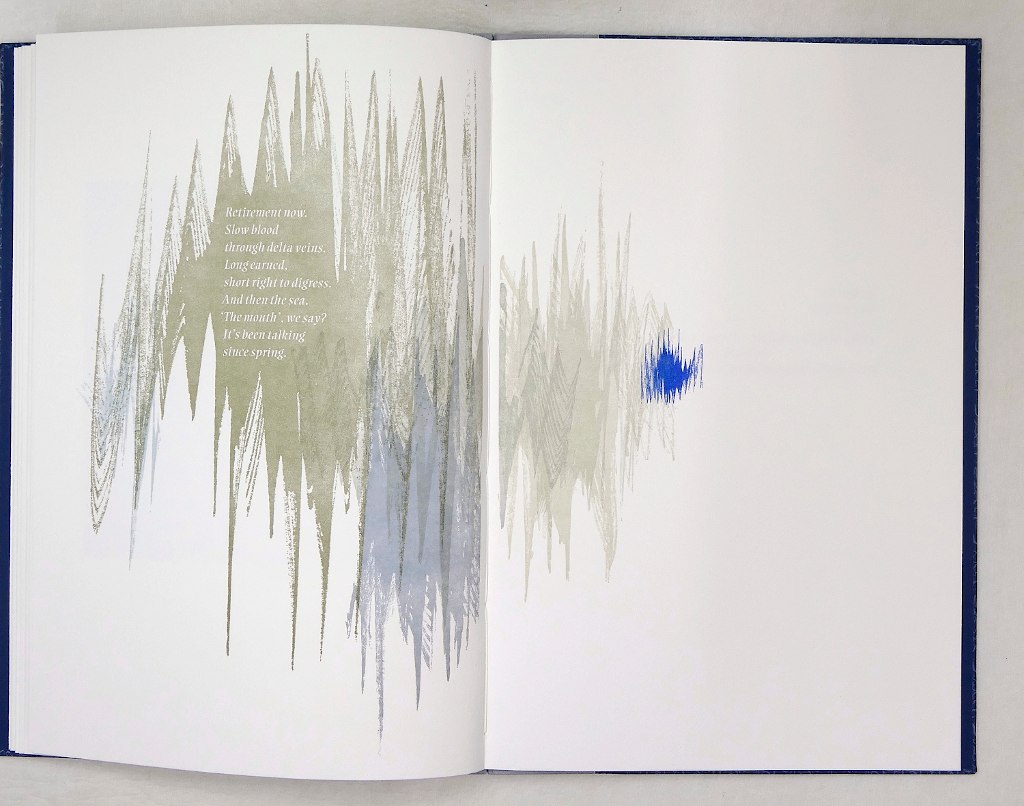
Retirement now.
Slow blood
through delta veins.
Long earned,
short right to digress.
And then the sea.
‘The mouth’, we say?
It’s been talking
since spring.


Words by Phil Madden; images by Paul L. Kershaw

There is just time to enter the Poetry Centre’s International Poetry Competition – it closes for entries today (14 September) at 23.00 BST! Our judge this year is the Forward Prize-winning poet Fiona Benson, and as always, we have two categories: Open and English as an Additional Language. The winners receive £1,000, with £200 for the runners up. For more details and to enter, visit our website.   

Text is copyright © Phil Madden and images copyright © Paul L. Kershaw, 2020. It is reprinted from Flow (Grapho Editions, 2020) by permission of the author and illustrator. For more details and to see additional images from the book, visit this page.

Notes from Grapho Editions:

These excerpts from the beginning, middle, and end of the book are from Flow, the fifth collaboration between poet Phil Madden and Paul L. Kershaw, printmaker and printer. Phil and Paul have won a number of awards for their books, including the Judges’ Choice Award at the Oxford International Fine Press Fair.

Through a series of words and images set across the open spread, Flow explores ideas around the movement of water, from estuary to spring. The poems have been written over recent years but not with any specific intention of them being part of a collection. They have been gathered together as the project developed and the idea of upstream progress became central. The images are a mix of the representational and abstract and are relief prints. Occasional small wood engravings combine with much larger shapes and textures. The book has been printed using an Albion press and a cylinder press. There are 50 copies in the edition and it is available to buy.

You can find out more about the book on Paul’s website, where you can also learn more about Phil and Paul’s ongoing collaboration.

Copyright information: please note that the copyrights of all the poems displayed on the website and sent out on the mailing list are held by the respective authors, translators or estates, and no work should be reproduced without first gaining permission from the individual publishers.
Cherwell valley nightscape –14 April 2020


No contrails blur the stars.
The Oxford road is free of cars.

Train wheels ring on distant rails.
Somewhere near a hunting owl screeches for a mate.

The Milky Way’s a champagne spume
unchallenged by an absent moon.

I borrow a breath of this shining air.
The vastness swallows what I offer in return.

by Carl Tomlinson

The Poetry Centre has launched its International Poetry Competition for 2020! We’re delighted to say that our judge this year is the Forward Prize-winning poet Fiona Benson. As always, we have two categories: Open and English as an Additional Language. The winners receive £1000, with £200 for the runners up. For more details and to enter, visit our website

The Centre also recently released a new online publication: the e-anthology ‘My teeth don’t chew on shrapnel’: an anthology of poetry by military veterans. This anthology features exciting, moving, and provocative work by US and UK veterans who were participants in workshops held by the Poetry Centre in 2019-20 and also includes writing about veterans (including an essay by WWI expert Jane Potter) and some writing prompts by Susie Campbell for anyone interested in developing their own writing. The anthology is free to download from the Poetry Centre website and we would very much welcome your feedback! E-mail us or fill out the short form on the site.

‘Cherwell valley nightscape – 14 April 2020’ is copyright © Carl Tomlinson, 2020. It is reprinted from The Scriptstuff Lockdown Anthology (Scriptstuff Entertainment, 2020) by permission. You can read more about the anthology here.

This week’s poem by Oxfordshire poet Carl Tomlinson comes from The Scriptstuff Lockdown Anthology, published by Leamington-based arts organisation Scriptstuff Entertainment. The anthology, edited by Scriptstuff Poetry founder Mike Took, includes contributions from 45 local poets both amateur and professional, each of whom has written about the impact of the pandemic on their lives, families, health and future and each of whom has previously supported or performed at a Scriptstuff Poetry event. Scriptstuff Poetry has been running several regular and one-off poetry events across the Midlands for a number of years and also organises the annual Leamington Poetry Festival. 

Proceeds from the sale of the anthology will support the rising costs of Scriptstuff’s ongoing activities, including poetry outreach initiatives into new communities and keeping the entire Leamington Poetry Festival free for everyone to attend. Find out more about the anthology and Scriptstuff’s work on the website and follow the organization on Facebook and Twitter to see if there is an event near you!

Carl Tomlinson is a poet, an independent business advisor, and a coach. He is a Chartered Accountant with a BA in Spanish and French Language and Literature. He completed his MA in Coaching and Mentoring Practice at Oxford Brookes University in 2019 during which his dissertation explored the nature of the Romantic Imagination and its applicability to coaching. He has been a regular attendee at the Scriptstuff Poetry night in Banbury, where he became such a popular contributor that in April 2019 he was the headline guest. In late 2019, Carl won the Shout Out for the Oxford Covered Market competition and you can watch Carl read his winning poem, ‘Market Forces’, here.

Copyright information: please note that the copyrights of all the poems displayed on the website and sent out on the mailing list are held by the respective authors, translators or estates, and no work should be reproduced without first gaining permission from the individual publishers.
Compassion, the life blood of the NHS


We are here for you 24/7, in your darkest, most vulnerable and weakest moments.
We are the holding of a hand to show you we are here through it all. 
We are people who make porridge at 4am for that eight-year-old boy whose beloved
granddad just died and was in need of distraction. 
We are the first people you see when you wake up after surgery and tell you it all went
well. 
We are the ears who listen to that 90-year-old lady recite from memory her favourite poem
perfectly because no family comes to visit. 
We are the eyes you show your wounds to which we dress without batting an eyelid.
We are the assistants who help you learn to walk again, and who motivate you to try again
after failing.
We are the people who make you a cup of tea after you find out the child you were
carrying will never be born alive.
We are the carers who shave you when you can’t, so you look smart for your wife even in
your hospital bed.
We are the staff who learn to sign their name so they can communicate in a way you
understand.
We are the staff that turn up every day and see so much. In this neverending battle we still
try. A little compassion goes further than you may ever know.
We are the NHS.

by Sarah Quinn

This week we are very pleased to share a poem by a nursing student at Oxford Brookes, Sarah Quinn. At a moment when the National Health Service is being given more attention and under even more pressure than usual, it’s great to be able to hear from someone like Sarah who is able to reflect on the challenges and rewards that come from working in the NHS. We’d like to thank Sarah for sharing the poem and send our grateful thanks also to all health workers for everything they are doing during such a difficult time.

‘Compassion, the life blood of the NHS’ is copyright © Sarah Quinn, 2020. It is reprinted by permission of the author. 

Sarah Quinn is a second-year Master’s student in Adult Nursing at Oxford Brookes and lives in Oxford. In addition, she is a nursing assistant – a role which she thoroughly enjoys. She also a keen interest in art, especially how this can be used as a medium for mental health promotion. She is an avid photographer with an eagle eye for seeing the beauty in the everyday. 

Sarah writes: ‘The prompt for writing this poem, ‘Compassion, the life blood of the NHS’, was a call to arms by an artist who wished to roll out an art project putting up posters in staff break rooms across the whole of the NHS (you can find the artist on Instagram: @notestostrangers). He asked for inspiration of what it was like to work within the NHS and why we do what we do.

At the end of a very busy, stressful and emotionally-tolling twelve-hour shift I was walking home mulling over my day (nearly in tears). In this moment of reflection I started to write on my phone to remind myself I am there for those patients and how lucky I am to be surrounded by such amazing colleagues.

Now more than ever the NHS is a symbol of hope and needs to be protected. I have personally looked after patients suffering with COVID-19 and seen both sides of this pandemic: the pressure that this puts on family, friends, businesses and people’s way of life. So for people out there reading this, know that your everyday sacrifices are making a difference on the front line. Together we can get through this and a little compassion goes a long way.’

You can find out more about nursing at Oxford Brookes here.

Copyright information: please note that the copyrights of all the poems displayed on the website and sent out on the mailing list are held by the respective authors, translators or estates, and no work should be reproduced without first gaining permission from the individual publishers.

Oliver’s Mysterious Poems

Calamari

I can taste the salty solution of the jaw dropping batter that had risen like a star
The texture of the calamari was so deeply fried it was like a waterfall waiting to be let free
When I look at the salted calamari I could feel my heart racing. It raced like a cannon ball
The colour was so dynamic it made me feel like a storm of rain.

A poem about goldfish

The wavy sea washed through my beloved body
Which was as brightly coloured as the sun.
I could see shimmering coral shining off the sea bed below my tail.
The colour of my rare body which sparkled as the raging waves clashed together.

Remembering the Soldiers

The horrific scene which set the soldiers trembling onto the gothic solid ground below their feet.

Goose Fair

As I walked down a street I could see the colours of a fair that made me tingle inside
The loud thumping music that shouted down my suffocating throat that was traumatized by the claustrophobic fear of horror.

Orange Sorbet

As I ripped open the fearsome tangerine
I could smell the delicious mouth-watering heart stopping flavours that had been beyond my reach
It felt like a combination of different types of acids had taken over
It was a hurricane that launched into my watering mouth which felt like a drizzling waterfall.

by Oliver Boyles

Tomorrow (Thursday) is National Poetry Day, and at a time when we celebrate the variety and importance of poetry, we’re very pleased to feature a young local poet in our Weekly Poem series. Many thanks to Oliver’s mum, Donna, for providing us with a biography of Oliver and for sharing a selection of his poems.

Oliver Boyles, aged 15, lived in Epwell, Oxfordshire. In June 2018 Oliver was unfortunately diagnosed with a spinal tumour that had been caused by radiotherapy to the spine from his previous cancer treatment when he was six years old (after which he went into remission for 8 years). This latest cancer diagnosis left him paralysed from the waist down and confined him to a wheelchair, and he received chemotherapy and palliative care as the tumour had metastasized. Sadly Oliver passed away peacefully in May 2019, surrounded by his family at home. During his illness Oliver found comfort in writing poems, especially about his love of food.

News from the Centre: for National Poetry Day, two of our Poetry Centre Interns – Joanne Balharrie and Zoe Mcgarrick – have hidden poems around the Headington campus and nearby area. Find a poem, tag us on social media with a photo of the poem, and win poetry prizes! The poems will be lurking around campus for a week, so be on the lookout!

The Poetry Centre has announced a number of upcoming events in November. Visit our Eventbrite page to sign up for readings by Tamar Yoseloff and Carmen Bugan, Doyali Islam and Mariah Whelan, our IF Festival event about our recent military veterans project, and the awards evening for our International Poetry Competition, featuring Jackie Kay. All events are free, and everyone is welcome!

Two selections from Running Rings

Running Rings by Phil Madden
Words by Phil Madden; prints by Paul L. Kershaw

Our International Poetry Competition is still open for entries until 2 September. There are two categories: Open and English as an Additional Language. Our judge is Jackie Kay, and you could win £1000! Find out more and enter here.

The Poetry Centre’s ignitionpress has just launched its three newest pamphlets by Joanna Ingham, Jennifer Lee Tsai, and Sarah Shapiro. You can read more about them and buy copies here.

Text is copyright © Phil Madden and images copyright © Paul L. Kershaw, 2019. It is reprinted from Running Rings by permission of the author and illustrator.

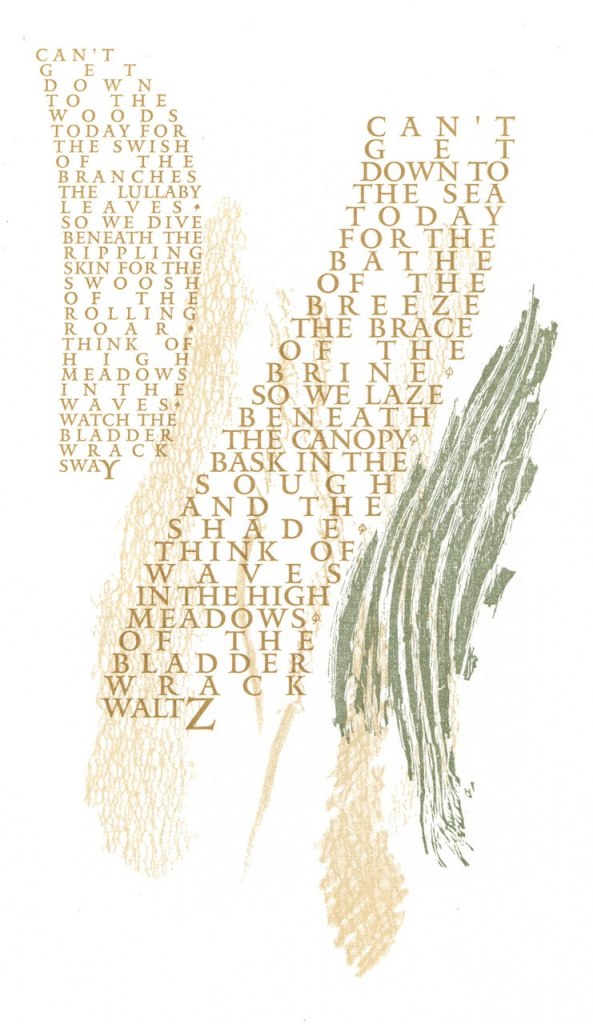
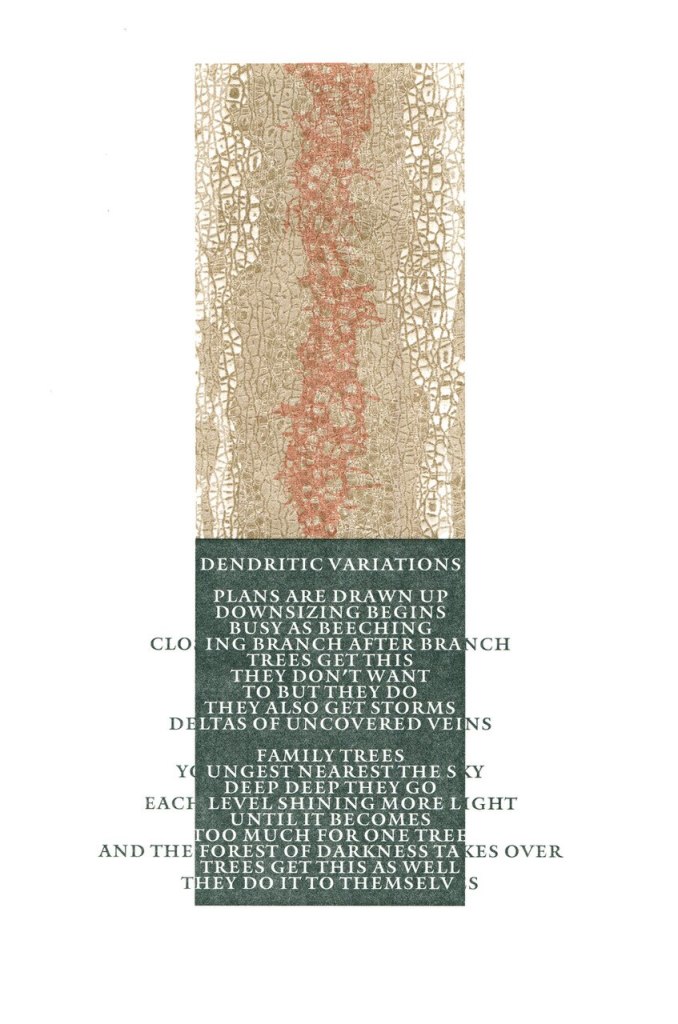
Phil Madden’s fourth book in collaboration with Paul L. Kershaw, printmaker and printer. Running Rings was a winner of the Judges’ Choice Award at the Oxford International Fine Press Fair in 2018. It is a limited edition of 70 copies, bound in quarter cream cloth with suminagashi marbled paper, 28pp, 365 x 255 mm. It was inspired by the trees in Studley Park, a World Heritage Site near Ripon.

As with their other collaborations, the images and words by Phil and Paul do not sit side by side artificially mirroring each other. Instead they are organically intertwined, using concrete poetry, fragmentation and varying focus and complexity. Together they invoke the essence of trees and woodlands in their glorious states of life, death, decay and renewal. You can find out more about the book and see further images from it on Paul’s website.

Copyright information: please note that the copyrights of all the poems displayed on the website and sent out on the mailing list are held by the respective authors, translators or estates, and no work should be reproduced without first gaining permission from the individual publishers.

Cat in an empty apartment

Dying – one doesn’t do that to a cat. 
For what can a cat do
in an empty apartment.
Scratching against the walls. 
Rubbing on the furniture.
In a way, nothing here was changed, 
and yet it has been altered.
In a way, nothing was moved,
and yet it has been confused.
In the evening, the light burns no more. 

Footsteps heard on the stairway,
but not those.
The hand, which lays fish on the plate, 
is too not the one, that did it once. 

Something does not begin here 
at its usual time.
Something does not happen here 
as it should.
Someone was, and was here 
then at-all-once disappeared 
and now he’s persistently gone.

It peered into all the cupboards.
Scampered across the shelves.
Wedged itself under the rug, investigated. 
Even went against the rule
and scattered the papers.

What else is there to do. 
Sleeping, waiting.

Let him dare return,
let him dare show himself.
Right away he’ll learn,
that one doesn’t do this to a cat. 
There will be a stroll in his direction 
as though utterly begrudging,
little by little,
on most offended paws.
And no leaps or chirps at first.


by Wisława Szymborska; translated by Amelia Sodhi

Kot w pustym mieszkaniu 

Umrzeć – tego się nie robi kotu. 
Bo co ma począć kot
w pustym mieszkaniu. 
Wdrapywać się na ściany. 
Ocierać między meblami.
Nic niby tu nie zmienione, 
a jednak pozamieniane. 
Niby nie przesunięte,
a jednak porozsuwane.
I wieczorami lampa już nie świeci.

Słychać kroki na schodach,
ale to nie te.
Ręka, co kładzie rybę na talerzyk, 
także nie ta, co kładła. 

Coś się tu nie zaczyna 
w swojej zwykłej porze. 
Coś się tu nie odbywa 
jak powinno.
Ktoś tutaj był i był,
a potem nagle zniknął
i uporczywie go nie ma. 

Do wszystkich szaf się zajrzało.
Przez półki przebiegło.
Wcisnęło się pod dywan i sprawdziło. 
Nawet złamało zakaz
i rozrzuciło papiery.
Co więcej jest do zrobienia.
Spać i czekać.

Niech no on tylko wróci, 
niech no się pokaże.
Już on się dowie,
że tak z kotem nie można. 
Będzie się szło w jego stronę 
jakby się wcale nie chciało, 
pomalutku,
na bardzo obrażonych łapach.
O żadnych skoków pisków na początek.


by Wisława Szymborska 

News from the Centre: in celebration of Jazz Appreciation Month, the Poetry Centre is thrilled to bring together contemporary jazz band Wandering Wires and our Beatin’ the Blues competition winners to create a fusion performance of jazz and poetry on Sunday 28th April from 8-9pm at Cafe Tarifa, Cowley Road, Oxford. Book your tickets (only £5) here.

Then on 30 April, we’re at Waterstones to host four Canadian poets (Chad Campbell, James Arthur, Stephanie Warner, and Jim Johnstone) and celebrate the recent publication of an exciting new anthology of Canadian poetry. Sign up to attend here.

And on 20 May we are collaborating with the Oxford Centre for Christianity and Culture to bring the acclaimed poet Gillian Allnutt  to Oxford – don’t miss her!

Find out more about these and other upcoming events, including a reading by Ilya Kaminsky and Shara Lessley and the launch of three new ignitionpress pamphlets on our Eventbrite page.

This is the second of two poems we are featuring to celebrate the Stephen Spender Prize for poetry in translation, whichis currently open for entries until Friday 12 July. Translate any poem from any language, ancient or modern into English, and be in the running for a cash prize and publication by the Stephen Spender Trust. The categories for the main prize are 14-and-under, 18-and-under and Open (adult), and will be judged by the Poetry Centre’s own Mary Jean ChanMargaret Jull Costa and Olivia McCannon. For the second year, the Trust is also running a ‘Polish Spotlight‘, with workshops in schools and a special prize for translation from Polish in the categories 10-and-under, 14-and-under and 18-and-under. You can find more details on the Trust’s website.

The winner of last year’s Polish Spotlight in the 18-and-under category was Amelia Sodhi. Writing about her translation of Wisława Szymborska’s poem ‘Cat in an empty apartment’, Amelia says: ‘There are many poems on grief, but never from a cat’s perspective. When I was looking for a poem to translate, ‘Kot w pustym mieszkaniu’ stood out to me. Szymborska captures a beautiful melancholy in this poem, through simplicity, repetition, and notably through the more subjective narration in the last stanza. She is able to recreate a certain feeling of grief that, so far, I have struggled to find in other poems; her illustration of the pain of loss isn’t something over the top but something small, and hence, even more potent.’

The Stephen Spender Trust was established in 1997 to honour Stephen Spender’s achievements as poet and translator of poetry, and as champion of the rights of creative artists and writers to free expression. Founding members who have since died include Valerie Eliot, Seamus Heaney, Ted Hughes, Czesław Miłosz, Harold Pinter and Natasha Spender. Inspired by Stephen Spender’s literary interests and achievements, the Stephen Spender Trust aims to widen appreciation of the literary legacy of Stephen Spender and his contemporaries and to promote literary translation. You can find out more on the Trust’s website.

Copyright information: please note that the copyrights of all the poems displayed on the website and sent out on the mailing list are held by the respective authors, translators or estates, and no work should be reproduced without first gaining permission from the individual publishers

On the Fjord

The night I left you
the fjord lay so still and clear 
as if the water itself
had lost all substance
It was like rowing in empty air 

Through a night so infinitely clear 
that I suddenly knew
I had to live without shadow
Up against the edge of sleep
away from the reach of your dreams 

The sound of years
in starless water. Like rowing
in one’s own heart
through a sorrow as deep and cold 
as death itself 

On the banks of the starlit shores 
along the strait, the houses lay 
and shone
with your face in every window 
And you did not see me

by Stein Mehren; translated from the Norwegian by Alice Fletcher

På fjorden

Den natten jeg forlot deg
lå fjorden så stille og gjennomsiktig 
som om selve vannet
hadde mistet all substans
Det var som å ro i tomme luften 

Over en natt så uendelig klar
at jeg plutselig visste
jeg måtte leve uten skygge
Helt nær søvnens skillelinje
utenfor rekkevidden av dine drømmer 

Lyden av årer
i stjernløst vann. Som å ro
i sitt eget hjerte
over en sorg så dyp og kald 
som døden selv 

Ved de stjerneklare breddene 
langs sundet, lå husene
og lyste
med ditt ansikt i alle vinduer 
Og du så meg ikke 

– Stein Mehren

The Centre has teamed up with IF Oxford Science and Ideas Festival and poet Kate Wakeling to run two poetry workshops for families on 9 and 15 April in Oxfordshire County Library. We’ll be encouraging participants to write brand new poems, ready for the IF Oxford Poetry of Science Competition. So if you know anyone aged 6-16 who is keen on poetry and science, please bring them along! You can sign up here.

Then on 30 April, we’re at Waterstones to host four Canadian poets (Chad Campbell, James Arthur, Stephanie Warner, and Jim Johnstone) and celebrate the recent publication of an exciting new anthology of Canadian poetry. Sign up to attend here.

And on 20 May we are collaborating with the Oxford Centre for Christianity and Culture to bring the acclaimed poet Gillian Allnutt to Oxford – don’t miss her!

Find out more about these and other upcoming events on our Eventbrite page.

This week’s poem was the winner of the 2018 Stephen Spender Prize for poetry in translation in the Open category, and the 2019 Prize is currently open for entries until Friday 12 July. Translate any poem from any language, ancient or modern into English, and be in the running for a cash prize and publication by the Stephen Spender Trust. The categories for the main prize are 14-and-under, 18-and-under and Open (adult), and will be judged by the Poetry Centre’s own Mary Jean ChanMargaret Jull Costa and Olivia McCannon. The Trust is also running a ‘Polish Spotlight‘ for the second year, with workshops in schools and a special prize for translation from Polish in the categories 10-and-under, 14-and-under and 18-and-under.You can find more details on the Trust’s website.

The winning translator last year was Alice Fletcher. She writes: ‘I have translated ‘På fjorden’ by Stein Mehren because I think it is a perfect example of a typically Norwegian poem; the language is clean, crisp, and deceptively simple, while also being very evocative. As with so much Norwegian literature and poetry, it is deeply connected to nature, as can be seen from the title itself. The language of Mehren’s poem is simple but so poignant, and I think it is a poem that really makes one stop and think. Moreover, it is a poem about love, however tragic, which I think really brings the poem to life for readers.’ You can read more of Alice’s reflections, and find out more about the other prizewinners for 2018,  here.

The Stephen Spender Trust was established in 1997 to honour Stephen Spender’s achievements as poet and translator of poetry, and as champion of the rights of creative artists and writers to free expression. Founding members who have since died include Valerie Eliot, Seamus Heaney, Ted Hughes, Czesław Miłosz, Harold Pinter and Natasha Spender. Inspired by Stephen Spender’s literary interests and achievements, the Stephen Spender Trust aims to widen appreciation of the literary legacy of Stephen Spender and his contemporaries and to promote literary translation. You can find out more on the Trust’s website.

Copyright information: please note that the copyrights of all the poems displayed on the website and sent out on the mailing list are held by the respective authors, translators or estates, and no work should be reproduced without first gaining permission from the individual publishers. 

The Clinic Bomber’s Mother

The trick, she guesses, is: be seen. Offer
coffee to police, walk among the living
without thinking of the dead. Never

apologize for being his mother. Keep
his photos on the mantel, his boyhood
room the same. Bring daisies to his plot,

ignore the other graves. Who really knows
who knows. She donates blood, is comforted
that strangers wear his clothes, irons

linens for St. Paul’s, whose confessionals
have never felt so cramped. Bless me, Father,
she admits, the bathroom hook still holds

his robe. There’s little time to think or rest.
More and more, the wafer tastes like flesh.

by Shara Lessley

The Poetry Centre is delighted to say that this week’s poet, Shara Lessley, will be reading from her work in Oxford this Thursday 22 March, when she will be launching her new collection The Explosive Expert’s Wife. Shara will be reading with Yvonne Reddick, whose work we featured last week and will be reading from her award-winning pamphlet Translating Mountains. Join us for what will be a terrific evening – from 7-9pm at the Society Café. Find more details on our website. Yvonne will also be discussing her academic research about Ted Hughes earlier in the day at Oxford Brookes – contact us for more details.

Have you seen our new ignitionpress pamphlets yet? We have another launch event at the Oxford Literary Festival this Sunday 25 March. To get a taste of what’s in store, watch videos of the poets: Lily Blacksell, Mary Jean Chan, and Patrick James Errington, on our ignitionpress pages, and buy the pamphlets here!

‘The Clinic Bomber’s Mother’ is excerpted from The Explosive Expert’s Wife by Shara Lessley. Reprinted by permission of the University of Wisconsin Press. © 2018 by Shara Lessley. All rights reserved. The poem was originally published in 32 Poems, 13.2 (Fall/Winter 2015).

‘Somewhere in the Middle / East, you sip coffee while I sleep…’ In sparse, powerful lines, Shara Lessley recalls an expat’s displacement, examines her experience as a mother, and offers intimate witness to the unfolding of the Arab Spring in her new collection, The Explosive Expert’sWife. Veering from the strip malls and situation rooms of Washington to the markets and mines of Amman, Lessley confronts the pressures and pleasures of other cultures, exploring our common humanity with all its aggressions, loves, biases, and contradictions. You can read more about Shara’s book on the publisher’s website.

Shara Lessley is a writer and teacher. The author of Two-Headed Nightingale and The Explosive Expert’s Wife, and co-editor of The Poem’s Country: Place & Poetic Practice, she is a former Wallace Stegner Fellow in Poetry at Stanford University. Shara’s poems and essays have appeared in PloughsharesThe Kenyon ReviewThreepenny ReviewThe Southern ReviewThe Gettysburg ReviewMissouri Review, and New England Review, among others. A recipient of scholarships from ArtsBridge and the Bread Loaf Writers’ Conference, Shara holds Bachelor’s degrees in Dance and English from University of California, Irvine, and an MFA in Poetry from University of Maryland. She was recently awarded Creative Writing Fellowship from the National Endowment for the Arts. She lives in Oxford. Find out more about Shara’s work on her website, and follow her on Twitter.

Copyright information: please note that the copyrights of all the poems displayed on the website and sent out on the mailing list are held by the respective authors, translators or estates, and no work should be reproduced without first gaining permission from the individual publishers.