
Brook

It’s so easy for me to imagine it I don’t even have to try. It’s why
I lost interest in the postcard maker. I hardly needed him anymore,
with his surfboard. I think he understood.                  That view
is stamped on my brain already, clear as day, except the grass
in the foreground is so dark it could almost be dusk overturned.
He told me the landslides are increasingly frequent, one for every
nice drop of rain. And so the cliff slips and the houses get closer
to the edge of it and the cliff gets weaker and so it goes on, and so
I take my love and I take it down. I think my mind’s eye is in my gut.
The lifeboat house is so low now it looks like a bunker, some kind
of air-raid shelter, to be on the safe side twice over. Little does it
know.                        The sunset takes longer these days, of course, with
further to go and less to hide behind.          I’d give a whole limb to be
there again. I’d know the right-handed cliff anywhere, with its slow
morning stretch, its curve, its crumble. Then there’s the section
where clay turns to chalk and the peregrines were nesting last time.
Elsewhere, we’d lost a good chunk of car park, and the seagulls didn’t
know where to land. Have you ever seen tarmac carried out to sea?
Like a jagged black ode to Noah’s Island?             It was not good
news at all. May it never appear in a photo.

by Lily Blacksell

Hear Lily read the poem by clicking below

The Oxford Brookes Poetry Centre is proud and delighted to introduce you to the first of the three poets whose work ignitionpress will be publishing in our first poetry pamphlets! Lily Blacksell’s pamphlet, There’s No Such Thing, together with A Hurry of English by Mary Jean Chan and Glean by Patrick James Errington, will be on sale on 14 February from the Brookes online shop, and there will be launch events on 7 March (at the Poetry Café in London), 8 March (at the Society Café in Oxford), and on 25 March (at the Oxford Literary Festival). You can find out more about these events on our website. We will be showcasing work by Mary Jean and Patrick in the next two instalments of the Weekly Poem.

Lily Blacksell is a British writer recently returned from New York, where she was working towards a poetry MFA on Columbia University’s Writing Program and also held a Teaching Fellowship. Lily writes poems for the page and the stage. Her work has appeared in Rockland LitLifejacketInk, Sweat & Tears, Poet’s CountryFoothill and Magma Poetry. She has written reviews and interviews for Boston ReviewSabotage and Prac Crit and was herself interviewed by Columbia School of the Arts and Impakter.

Lily has performed her work at numerous venues, such as Berl’s Brooklyn Poetry Shop, Bowery Poetry Club, and Dead Rabbits (US), and Cheltenham Poetry Festival, Battersea Arts Centre (as part of Battersea Literature Festival), Howl, Word Up, and Boomerang (UK). In 2013, Apples and Snakes commissioned a piece of original spoken word theatre from Lily, which was performed at Lit Fuse, and in 2015 she was a finalist in the Roundhouse Poetry Slam. In 2017 Lily was nominated for The Pushcart Prize and Best New Poets (United States and Canada).

ignitionpress is a new poetry pamphlet press with an international outlook which publishes original, arresting poetry from emerging poets, and established poets working on interim or special projects. The Managing Editor of the press is Les Robinson, who was the founder and director of the renowned poetry publisher tall-lighthouse until 2011. You can learn more about the press on the Poetry Centre website.

Copyright information: please note that the copyrights of all the poems displayed on the website and sent out on the mailing list are held by the respective authors, translators or estates, and no work should be reproduced without first gaining permission from the individual publishers.
Follow the Poetry Centre on Facebook and Twitter.

Bunny Says

I’m hovered by the gate post again, waiting for Bunny
with my bag full of sour bread, just like Bunny
wanted, and jimjangled, can’t see Bunny.
Have I come dog-keen too early
Have I worn the right red boots
Have I stopped you raging Bunny
and Bunny says Bunny says Bunny says

Now we’re chasing my sister and Bunny
is joyful, but trickster and thug he is, is Bunny
he loves the way the brambles bite, does Bunny
so does she love the scramble too
so does she cry for being alive
so does she gasp for young night, Bunny
and Bunny says Bunny says Bunny says

In the garage, we unjunk some purple paint but Bunny
is not in think of plans or undead dusk. No, Bunny
charcoals out his plans for an everyoung Bunny
Will he do this thing and name it servant
Will it lollop methodically, coughing out washers
Will you will it to kill me, Rust Commander Bunny?
and Bunny says Bunny says Bunny says

by Kirsten Irving

News from the Centre! We are excited to say that this week’s poet, Kirsten Irving, will be reading alongside Caroline Smith this Thursday from 7-9pm at our new venue, the Society Café in central Oxford. (We featured ‘Teenager’, a poem from Caroline’s book The Immigration Handbook – shortlisted for the Ted Hughes Award – back in January.) All are welcome to the reading, and you can buy tickets (£4) via the Brookes Shop and also on the door. We hope to see you there! Next Thursday, the Society Café hosts another reading – this time with Siobhán Campbell and Kate Clanchy, and you can find tickets for that event here.

We would also be delighted to see you at our International Poetry Competition awards evening on Friday 24 November at Oxford Brookes. The event, which runs from 6.30-8pm in the John Henry Brookes Building, will feature readings from the winners and shortlisted poets in this year’s competition, and also a reading from our judge, Helen Mort. And cake. To book a place, please e-mail poetrycomp@brookes.ac.uk

‘Bunny Says’ is an unpublished poem and is copyright © Kirsten Irving, 2017. It is reproduced with the permission of the author.

Kirsten Irving is a poet, editor, copywriter, and voice actor. Her poems have appeared widely in various online and print magazines. She has published three pamphlets – No, Robot, No! with Jon Stone, What To Do, Riotous with Jon Stone and a debut full-length collection Never NeverNever Come Back (Salt Publishing, 2012). The poem ‘Bunny Says’ is from her forthcoming collection, tentatively titled Popgun. Kirsten is also one of the founding editors of experimental poetry press Sidekick Books. You can read more about Kirsten’s work on her website, follow her on Twitter, or come and hear her read this Thursday!

Copyright information: please note that the copyrights of all the poems displayed on the website and sent out on the mailing list are held by the respective authors, translators or estates, and no work should be reproduced without first gaining permission from the individual publishers.

Willow Tit

Her beak is a split thorn
carving a zipline,
undressing the seedpod.

Ignore her calls,
those sudden shudders
of breath in a pinetree.

Ignore her completely.
Some birds in China
sculpt nests from spit;

she’ll hammer a home
in your huge neglect,
eyeshadowed, black-capped.

In the land of the dead
the judges will balance
your heart and her feather.

by John Clegg

Happy World Poetry Day! This Thursday, our Visiting Professor Michael Parker and Aleksandra Parker discuss the new English edition of Andrzej Franaszek’s biography of Nobel Prize-winning Polish poet Czesław Miłosz, which they have translated and edited, and his relationship with Seamus Heaney. There is more information about the book on the Harvard Press website. The event takes place in room JHB 205 of the John Henry Brookes Building at Oxford Brookes University, is free to attend, and refreshments will be served. All are welcome!

Our next poetry workshop will be led by poet and teacher Sarah Hesketh and is entitled ‘“more than skin can hold”: Writing People’. It will take place on Saturday 1 April from 10.30-4.30pm in the John Henry Brookes Building here at Oxford Brookes University. The workshop will consider the questions that arise when we attempt to represent and remember others in our writing, and all are welcome! Visit our website for more information and to sign up. Please note that places are limited!

Finally, this Sunday, the Director of the Poetry Centre, Niall Munro, will be in conversation with poet and publisher Andy Croft at the Oxford Literary Festival about why poetry matters. More details can be found on the OLF website.

‘The Willow Tit’ is copyright © John Clegg, 2011. It is reprinted from Birdbook I: Towns, Parks, Gardens & Woodland (Sidekick Books, 2011) by permission of Sidekick Books

John Clegg was born in Chester in 1986, and grew up in Cambridge. In 2013, he won an Eric Gregory Award. He has published a pamphlet, Captain Love and the Five Joaquins (The Emma Press, 2014) and a full-length collection, Holy Toledo! (Carcanet, 2016) He works as a bookseller in London.

Notes from Sidekick Books:

With this poem we continue our selection of poems from Sidekick Books’ four volumes of Birdbooks. In 2009, with two micro-compendiums under their belt, Kirsten Irving and Jon Stone, the editors at Sidekick, discussed the idea of a book of bird poetry – but one in which less well known species were on equal terms with the popular ones. There are dozens of poems about herons, eagles, ravens and nightingales, not so many about the whimbrel, the ruff, the widgeon or the hobby. Paper-cut artist Lois Cordelia was recruited to give the series its distinctive covers, and over 150 artists and illustrators were commissioned over six years to complete the series. The first volume is now in its second printing. Find out more about the Birdbook series on the Sidekick website.

Sidekick Books is a cross-disciplinary, collaborative poetry press run by Kirsten Irving and Jon Stone. Started in 2009 by the ex-communicated alchemist Dr Fulminare, the press has produced themed anthologies and team-ups on birds, video games, Japanese monsters and everything in between. Sidekick Books titles are intended as charms, codestones and sentry jammers, to be dipped into in times of unease. You can follow Sidekick’s work on the press’s website and via Twitter.

Copyright information: please note that the copyrights of all the poems displayed on the website and sent out on the mailing list are held by the respective authors, translators or estates, and no work should be reproduced without first gaining permission from the individual publishers.

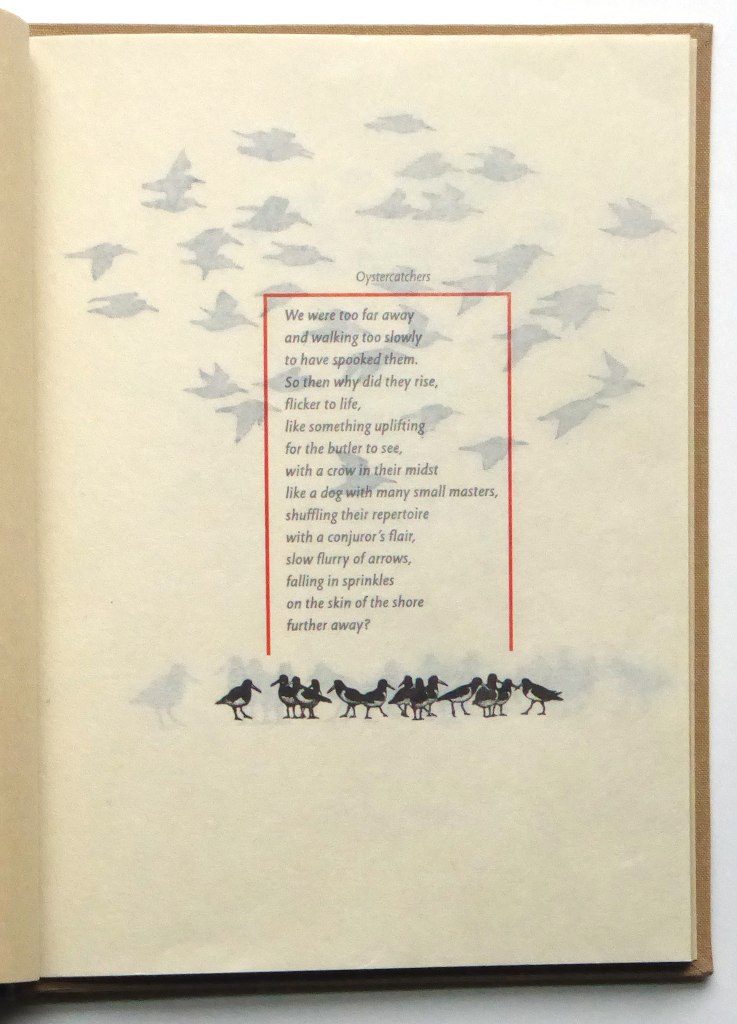
Oystercatchers

We were too far away
and walking too slowly
to have spooked them.
So then why did they rise,
flicker to life,
like something uplifting
for the butler to see,
with a crow in their midst
like a small dog with many small masters,
shuffling their repertoire
with a conjuror’s flair,
slow flurry of arrows,
falling in sprinkles
on the skin of the shore
further away?

And then why rise again,
and then handbrake turn
not screeching like swifts,
to swirl their way back
to return to exactly
the point where they started.
To settle again,
piping down, down, down?
Why else but the sheer
species élan
of being alive?


by Phil Madden, with illustrations by Paul L. Kershaw

‘Oystercatchers’ is copyright © Phil Madden, 2015, and the illustrations are copyright © Paul L. Kershaw. It is reprinted from The Amphibious Place (Grapho Editions, 2015) by permission of Grapho Editions.

Phil Madden has worked with Paul Kershaw on two other limited-edition works: Wings Take Us (2009) and Paths (2013). Both are published by Grapho Editions. He has also produced limited-edition works with the engraver Peter Lazarov: The Urban Moon (2009) and The Puppeteer and the Puppet (2012), published by Pepel Press. Phil has had exhibitions of concrete poetry in Brussels and the UK and won the Cinnamon Press Concrete Poetry Competition in 2012. The Tea Way (Gean Tree Press) was published electronically in 2012.

After many years as a printmaker specialising in wood engraving, during which time he has become recognised as one of the country’s leading wood engravers, Paul Kershaw has extended his interests towards the design, printing and publishing of handmade books in small editions. The three books created in collaboration with Phil Madden have been printed using hand presses, on fine-quality paper and display a variety of graphic techniques to find new ways of combining text and image. Paths received a Judges’ Choice Award at the 2013 Fine Press International Book Fair in Oxford. The Amphibious Place was also chosen for this award in the 2015 Book Fair, as well as receiving the Toby English Prize for the most original book.

The Amphibious Place (215 x 175mm, 20pp, published by Grapho Editions, October 2015; price: £125, plus postage & packing). The book is printed on Atsukuchi and Kozuke paper, using an Albion handpress and a cylinder press. There are 60 copies in the edition. The setting is Magma. It is cloth bound with a stab binding and housed in a matching slipcase. This book has as its theme the seashore, the space shared by sea and land. Both text and image are centred horizontally along a single line, and the in/out cycle of the tides has inspired various structural pairings and dualities. The binding style, which doesn’t allow the book to lie open, is in part intended to suggest restless motion.

Phil Madden’s poem ‘Oystercatchers’ is divided between two pages, a recto and the following verso, using one sheet of thin paper folded at the fore edge. The inner face has been printed as well as the outer one so that is possible to see through the paper to the layers underneath. To learn more about the book and see further pages from it, visit Paul Kershaw’s website.

You can also get in touch with Paul via e-mail: plkershaw@mac.com

Copyright information: please note that the copyrights of all the poems displayed on the website and sent out on the mailing list are held by the respective authors, translators or estates, and no work should be reproduced without first gaining permission from the individual publishers.

Historia


                   moving on or going back to where you came from


                                               Amy Clampitt


                   it is not the substance of a man’s fault

                   it is the shape of it

                   is what lives with him, is what shows


                                               Charles Olson


a room crammed with sharp toys                              


a field zesty with fire   


                   history as historia        


        cool as a shot to the mouth    


                            *


                                      in pinched shoes  

                                               cataleptic            


                            merely to show up


                   the birdlime viscidity of the garden

                   the scalpel-like finger

                              of a shriveled leaf—                     


                   not accusatory   

                                               shadowed only

                                                         by itself

                   not pointing

         towards a balance-act 

                                             but balancing         


                            *


I was six and made of violins

                                               stumped

                            by metronomic light 


I wanted to energise him away

         like glucose

                   globed

         into whiteness—


         a voice spoken slantwise

                            but faraway—    


                                      sleeping it off


                   I traveled in the dark

                   so as not to be seen    


                            *


         dusk-nervousness

         in what is             unclaimed


I wait and fail      

         paying off warders

                   at your door—    


                                               the thrillbox

                                               of birthdays


                   whalecalls from waterclotted

                            condensation


                                      the gazebladed kitchen 


                   the uplander silences of television


                                      blackish fingernails

                                                         from window-mould


                            eyes goggled

                                      towards a lit hearth 

                                               fringe fraying


                            or cupping at the curtain frame

                                      fearful of fire 

                                               on the domestic zodiac


bees cried in their flower-coats

                   collecting honey


                            *


                   how the air divides      

                            like cutting a loaf—


         as much childed           

                   as fevered


                                      left alone

                            in the dry season         


         to feed from the day’s nutrients—


                                                                  naphtha mirage 

                                                                            over the wheatfield

                                                                                              at sunset


                                               foxfur grinning on a spidersweb


                                                                  dialysis of rain

                                                                            inside a garden well     


                                                                  equal to breath             


                            *


         —to hear the substance of the earth

                                      to know its shape        


                   blessèd as an egg

   and yet—


                   and yet bombarded

                            by the radio impulse

                                      of survival


                   the whistlework of money—


her ivied hair       

                   trenched at the oven or

         admonished at the fire-grate


                            *


shuffle-worn cards

                                      blanked-out letters

                                               from the on-dead 


how life tickles the palm         at twenty


                            *


                   dreaming up worser devils


thinking the lesser disease might be

                                               loneliness—


no-one to ignite

                   the red-eyed bird

                            of your mind


no-one told you why

                                        love

                                               blunts


                            *


if the bones sing          


if chaos is chaos         

         returned—          


                                               no atom nuclei

                   no definitive cure         


*


enter fortune


         a ransacked house   

                   half-emptied—   


that which remains

preserved in boxes


                   now bulges

         like a museum   


                            *


baffled voices     vow trounces

         —as if from any archive—


I lean over and touch my ear

         to the grid complex—


                            like hearing ritual cannibalism

                                      in the byways of a river


by James Byrne

Please join us on Friday 19 February from 6-8pm here at Oxford Brookesto celebrate the prize-winning poets of the ‘Open’ and ‘English as a Second Language’categories in our inaugural International Poetry Competition. The event willinclude readings from the winners, as well as an exciting showcase of work fromlocal young poets, mentored by award-winning writer, Kate Clanchy. Lightrefreshments will follow. If you would like to attend, please let us know viae-mail: poetrycomp@brookes.ac.ukby 10 February. 

‘Historia’ is copyright © James Byrne, 2015. It is reprinted from White Coins (Arc Publications, 2015) by permission of Arc Publications.

James Byrne’s most recent poetry collection Blood/Sugar, was published by Arc Publications in 2009. Byrne is the editor of The Wolf, an internationally-renowned poetry magazine, which he co-founded in 2002. He won the Treci Trg poetry festival prize in Serbia and his Selected Poems: The Vanishing House was published in Belgrade. Byrne lives in Liverpool and is a Lecturer in Creative Writing at Edge Hill University. His poems have been translated into several languages including Arabic, Burmese and Chinese and he is the International Editor for Arc Publications.

White Coins rewards the reader with a nomadic poetry for the 21st century; one that mingles personal, social and historical spaces whilst celebrating, at all times, linguistic versatility and innovation. Read more about the book on Arc’s website, and hear James read from his work on the Archive of the Now site.

Since it was founded in 1969, Arc Publications has adhered to its fundamental principles – to introduce the best of new talent to a UK readership, including voices from overseas that would otherwise remain unheard in this country, and to remain at the cutting edge of contemporary poetry. Arc also has a music imprint, Arc Music, for the publication of books about music and musicians. As well as its page on Facebook, you can find Arc on Twitter. Visit Arc’s website to join the publisher’s mailing list, and to find full details of all publications and writers. Arc offers a 10% discount on all books purchased from the website (except Collectors’ Corner titles). Postage and packing is free within the UK.

Copyright information: please note that the copyrights of all the poems displayed on the website and sent out on the mailing list are held by the respective authors, translators or estates, and no work should be reproduced without first gaining permission from the individual publishers.

01 43 15 50 67

for Fabienne

By the time we finished talking it has snowed
We’d laughed and sighed like a pair of sisters
Can you see this caribou from your window it’s a cloud
A moose an ermine little moving fox
It changes every moment changes to sky-blue-sky
If the night has stars in it it’s a promise of blue
Have you checked out the chimney-stacks the great she-bears
We ought to see oceans more
We shouldn’t need a second glance to make out a giraffe
All white white white white where you are as well?
A squid a cuttlefish an octopus might add a splash of ink
All white white white without red rabbit eyes
We mustn’t make each other late time’s getting on I’d better go
There are some in dotty frocks and some in geometric shapes
And oh I almost forgot
Old things float up and new ones too
A slotted spoon a convalescence or a precious stone
Jewel of sleeping water there was a cat called that
It was
Drowned jewel
Clouds don’t miaow though jewellery can trickle down
When we stopped our oneversation we came down as snow

by Valérie Rouzeau; translated by Susan Wicks

This is the final Weekly Poem of 2015. The poems will return to your inbox on 11 January. A very Merry Christmas and Happy New Year to all our readers!

‘01 43 15 50 67’ is copyright © Valérie Rouzeau; translated by Susan Wicks, 2013. It is reprinted from Talking Vrouz by Valérie Rouzeau, published by Arc Publications (2013).

This poem continues our series featuring work from collections shortlisted for The Poetry Society’s Popescu European Poetry Translation Prize 2015, judged by Olivia McCannon and Clare Pollard, and supported in 2015 by the British Council. The winner of the competition was Iain Galbraith, who translated Jan Wagner’s book Self-Portrait with a Swarm of Bees (Arc Publications, 2015). You can find out more about the competition and all the shortlisted books on the Poetry Society website.

Susan Wicks
, poet and novelist, was born in Kent, and has lived and worked in France, Ireland and America. She is the author of six collections of poetry including House of Tongues (2011), Singing Underwater (1992), which won the Aldeburgh Poetry Festival Prize, and The Clever Daughter (1996), which was shortlisted for both the T. S. Eliot and Forward Prizes. She was one of the Poetry Society’s ‘New Generation Poets’ in 1994. Cold Spring in Winter (2010), her translation of Valérie Rouzeau’s first major collection, Pas revoir, was shortlisted both for the Oxford-Weidenfeld Prize for Literary Translation and the International Griffin Prize for Poetry, and won that year’s Scott Moncrieff Prize for Translation from French. Her translation of Valérie Rouzeau’s second collection in English, Talking Vrouz, won the Oxford-Weidenfeld Prize for Literary Translation in 2014. You can read a discussion with Susan and Valérie on the Arc website, and hear the pair read one of Valérie’s poems and its translation together.

Valérie Rouzeau was born in 1967 in Burgundy, France and now lives in a small town near Paris, Saint-Ouen, well-known for its flea-market. She has published a dozen collections of poems, including Pasrevoir (l’Idée Bleue, 1999), Va où (Le Temps qu’il Fait, 2002) and more recently Apothicaria (Wigwam, 2007) and Mange-Matin (l’Idée Bleue, 2008). She has also published volumes translated from Sylvia Plath, William Carlos Williams, Ted Hughes and the photographer Duane Michals. She is the editor of a little review of poetry for children (from 5 to 117 years old) called dans la lune and lives mainly by her pen through public readings, poetry workshops in schools, radio broadcasts and translation. Valérie was selected to represent France in the 2012 Cultural Olympiad Poetry Parnassus in London.

Since it was founded in 1969, Arc Publications has adhered to its fundamental principles – to introduce the best of new talent to a UK readership, including voices from overseas that would otherwise remain unheard in this country, and to remain at the cutting edge of contemporary poetry. Arc also has a music imprint, Arc Music, for the publication of books about music and musicians. As well as its page on Facebook, you can find Arc on Twitter. Visit Arc’s website to join the publisher’s mailing list, and to find full details of all publications and writers. Arc offers a 10% discount on all books purchased from the website (except Collectors’ Corner titles). Postage and packing is free within the UK.

Copyright information: please note that the copyrights of all the poems displayed on the website and sent out on the mailing list are held by the respective authors, translators or estates, and no work should be reproduced without first gaining permission from the individual publishers.

‘the is of the silence in the room’

the is of the silence in the room
the is of the walls, each so different
the is of the sunshine on the curtain
the greying is of the dust
through the thin is of the glass
the is of the sparrow outside the window
the is of the child on the grass, chasing a butterfly
the is of the butterfly in the net
the floating is of the cloud

and once again: I am

in this vast
circular spherical nobody’s
agape virulent scorching
grass-strong swift-winged quick-legged
dripping rabid
acute
is


by Krystyna Miłobędzka; translated by Elżbieta Wójcik-Leese

the is of the silence in the room’ is copyright © Krystyna Miłobędzka; translated by Elżbieta Wójcik-Leese, 2013. It is reprinted from Nothing More by Krystyna Miłobędzka, published by Arc Publications (2013).

This poem continues our series featuring work from collections shortlisted for The Poetry Society’s Popescu European Poetry Translation Prize 2015, judged by Olivia McCannon and Clare Pollard, and supported in 2015 by the British Council. The winner of the competition was Iain Galbraith, who translated Jan Wagner’s book Self-Portrait with a Swarm of Bees (Arc Publications, 2015). You can find out more about the competition and all the shortlisted books on the Poetry Society website.

Elżbieta Wójcik-Leese writes between English, Polish and Danish; her multilingual texts have appeared in such journals as ShearsmanCordite Poetry ReviewModern Poetry in Translation, on the London Underground and in anthologies. She has published numerous translated collections including Nothing More (Arc, 2013), her selection from Krystyna Miłobędzka, and Salt Monody (Zephyr Press, 2006) by Marzanna Kielar. She has co-edited Carnivorous Boy Carnivorous Bird: Poetry from Poland (Zephyr Press, 2004), guest-edited Polish issues of Poetry Wales and Modern Poetry in Translation, and is a contributing editor at Poetry Wales, where she regularly reviews translated books. She teaches poetry-in-translation courses for the Poetry School in London and works at the Centre for Internationalisation and Parallel Language Use, University of Copenhagen. Arc’s website features three essays by Wójcik-Leese about her translations of Miłobędzka’s poetry.

Krystyna Miłobędzka was born in Margonin, Poland, in 1932. She is an author of twelve books of poetry, including a collected poems, Zbierane1960-2005 (Gathered 1960-2005), which appeared in 2006, and zbierane, gubione (gathered, lost) in 2010. She has been the recipient of numerous awards, was nominated for the NIKE Prize in 2006, and won the Silesius Award in 2009, and again in 2013 for Lifetime Achievement. She lives in Puszczykowo near Poznań. You can find out more about Nothing More on the Arc website.

Copyright information: please note that the copyrights of all the poems displayed on the website and sent out on the mailing list are held by the respective authors, translators or estates, and no work should be reproduced without first gaining permission from the individual publishers.

an essay on midges


as if all the letters had suddenly
floated free of a paper
and formed a swarm in the air;

they form a swarm in the air,
of all that bad news telling us
nothing, those skimpy muses, wispy

pegasuses, only abuzz with the hum
of themselves, made from the last twist
of smoke as the candle is snuffed,

so light you can hardly say: they are –
looking more like shadows, umbrae
jettisoned by another world

to enter our own, they dance, their legs
finer than anything pencil can draw,
with their miniscule sphinx-like bodies;

the rosetta stone, without the stone.


by Jan Wagner, translated by Iain Galbraith

There are two exciting Poetry Centre events this week: on Wednesday we host a spoken word/open mic evening, with a featured performances by Maddie Godfrey (Finalist in the Australian National Poetry Slam, 2015), andlive music by Steph Masucci. You can find more details on our Facebook page.

Then on Thursday we launch our occasional lunchtime poetry reading, Eat My Words, with Emma Jones and Harry Man. All are very welcome. The reading will be from 12.15-1pm in T.300 (Tonge Conservatory), Gipsy Lane, Oxford Brookes. Contact us for more details.

‘an essay on midges’ is copyright © Jan Wagner, 2015. It is reprinted from Self-Portrait with a Swarm of Bees (Arc Publications, 2015) by permission of Arc Publications.

Over the next few weeks, we will be featuring poems from collections shortlisted for The Poetry Society’s Popescu European Poetry Translation Prize 2015, judged by Olivia McCannon and Clare Pollard, and supported in 2015 by the British Council. We begin with the winner of the competition, which was announced this evening. You can find out more about the competition and all the shortlisted books on the Poetry Society website.

Iain Galbraith‘s poems have appeared in Poetry ReviewPN ReviewEdinburgh ReviewTimes Literary SupplementIrish PagesNew Writing and many other journals and books. He is the editor of five poetry anthologies and translates poetry, fiction and drama. A winner of the John Dryden Translation Prize and the Stephen Spender Prize for Poetry Translation, his recent translated books include W.G. Sebald’s poetry and John Burnside’s selected poems in German. He is an occasional lecturer, and in 2014-15 taught Poetics of Translation at the University of Applied Arts in Vienna. He was born and grew up in the west of Scotland and now lives in Wiesbaden, Germany.

Of the winning collection, the judges said: ‘Galbraith converts every challenge (formal, lexical, metrical) into an opportunity, matching Wagner’s ingenuity and investment at every step, having internalized the “primal syntax” so completely that everything he writes hits the mark. The result is a perfect sufficiency: a set of poems in English that somehow inhabit the same skin as the German, with their own autonomous heart and lungs.’

Jan Wagner studied English in Hamburg, Dublin and Berlin, where he has lived since 1995. A poet, essayist and translator of British and American poetry by Charles Simic, Simon Armitage, Matthew Sweeney, and Robin Robertson, he was also, until 2003, co-publisher of The Outside of the Element, a boxed loose-leaf periodical based on an idea by Marcel Duchamp. He has published six volumes of poetry and has received numerous awards, including the Mondsee Poetry Award (2004), the Ernst Meister Prize for Poetry (2005), the Wilhelm Lehmann Prize (2009) and the Friedrich Hölderlin Prize (2011).

Since it was founded in 1969, Arc Publications has adhered to its fundamental principles – to introduce the best of new talent to a UK readership, including voices from overseas that would otherwise remain unheard in this country, and to remain at the cutting edge of contemporary poetry. Arc also has a music imprint, Arc Music, for the publication of books about music and musicians. As well as its page on Facebook, you can find Arc on Twitter. Visit Arc’s website to join the publisher’s mailing list, and to find full details of all publications and writers. Arc offers a 10% discount on all books purchased from the website (except Collectors’ Corner titles). Postage and packing is free within the UK.

Copyright information: please note that the copyrights of all the poems displayed on the website and sent out on the mailing list are held by the respective authors, translators or estates, and no work should be reproduced without first gaining permission from the individual publishers.

In the Orchard of Pomegranates

Then you wonder, astonished, who am I? I am a mustard seed in the middle of the sphere of the moon.
Moses Cordovero, Or Ne’erav (The Sweet Light), trans. Ira Robinson

When I was a girl, holy in sending,
alive in receiving, I knew a word
was, like an angel, flaming, both message
and messenger.

Electric the flowerin my eye, the opening of the heart:
if ‘house’ is a prison, ‘home’ is a latticed
(look up) constellation. At such elevation,
this is return under you the harvest moon.                                                

                                                  Anemone,
                                                  anemometer.

I have nothing withheld in my hands, but
nothing. Doubled. The seed of. Your wish for.

by Sophie Mayer

Two notes from the Centre: on Friday 20 November there will be a free poetry workshop in Oxford on the theme of ‘history’, led by experienced poets. From myths, collective stories or personal narratives, what does history mean to you? To join, email your name and affiliation to oxfordpoetry.history@gmail.com The workshop will take place from 3-5pm
 in the Old Library, University Church of St Mary the Virgin, High St, Oxford, OX1 4BJ.


And on Wednesday 25 November, the Centre is hosting a spoken word/open mic event in the Main Lecture Theatre, Clerici Bldg, Gipsy Lane on the Headington campus. All are welcome to this event, which will feature numerous local poets and a set from Maddie Godfrey (Australian National Poetry Slam Finalist, 2015). You can find more details and register your interest via the Facebook page.
 ‘In the Orchard of Pomegranates’ is copyright © Sophie Mayer, 2015. It is reprinted from (O) (Arc Publications, 2015) by permission of Arc Publications.

Notes from Arc Publications:


Sophie Mayer 
is a writer, editor and educator. Her poetry has been translated into Russian, Greek, Dutch, and Japanese, and has appeared on poster hoardings in Dublin and as part of Yoko Ono’s Meltdown 2013. Previous collections include Her Various Scalpels (Shearsman, 2009), The Private Parts of Girls (Salt, 2011), Kiss Off (Oystercatcher, 2011) and signs of the sistership (with Sarah Crewe, KFS, 2013). She is a film critic and scholar, author of The Cinema of Sally Potter, and (for the Oxford Handbook on Contemporary British and Irish Poetry), ‘Cinema Mon Amour’, the definitive essay on British poetry and film. 

(O) is Sophie Mayer’s fourth published poetry collection. Energetic, determined, politicised, contemporary and classical. Brimming with wit, these poems endeavour into the challenges, obstacles and successes which accompany the path into womanhood. A powerful poetic voice, which serves as a testament to the women who live in the cracks of history. You can read more about the book on the Arc website, and more about the author on her own site. You can also follow her on Twitter.

Since it was founded in 1969, Arc Publications has adhered to its fundamental principles – to introduce the best of new talent to a UK readership, including voices from overseas that would otherwise remain unheard in this country, and to remain at the cutting edge of contemporary poetry. Arc also has a music imprint, Arc Music, for the publication of books about music and musicians. As well as its page on Facebook, you can find Arc on Twitter. Visit Arc’s website to join the publisher’s mailing list, and to find full details of all publications and writers. Arc offers a 10% discount on all books purchased from the website (except Collectors’ Corner titles). Postage and packing is free within the UK.

Copyright information: please note that the copyrights of all the poems displayed on the website and sent out on the mailing list are held by the respective authors, translators or estates, and no work should be reproduced without first gaining permission from the individual publishers.

Sudden Collapses in Public Places

like buildings, people can disintegrate
collapse in queues, or in a crowded street

causing mayhem, giving kids bad dreams
of awkward corpses, policemen, drops of blood

but I’m stood here, a miracle of bones
architecturally balanced in my boots

I feel each joint, each hinge and spinal link
jolting to the rhythm of my breath

aware of every tremor in my joists,
and yet I’m scared I haven’t done enough

to be re-enforced and girded, Christ, I fear
those flowers tied to lamp posts, dread the crash

by Julia Darling

Two upcoming events: on Monday 16 November at the Albion Beatnik Bookshop from 7.30pm, the Poetry Centre co-hosts a reading by visiting US poet celeste doaks and Hanne Busck-Nielsen. It promises to be a lively and exciting event. Find out more on our Facebook page.

And then on Friday 20 November there will be a free poetry workshop in Oxford on the theme of ‘history’, led by experienced poets. From myths, collective stories or personal narratives, what does history mean to you? Does living in Oxford, a place steeped
 in history and memories, inspire you to write about the past? To join, email your name and affiliation to oxfordpoetry.history@gmail.com The workshop will take place from 3-5pm
 in the Old Library, University Church of St Mary the Virgin, High St, Oxford OX1 4BJ.

‘Sudden Collapses in Public Places’ is copyright © Julia Darling, 2003. It is reprinted from Indelible, Miraculous (Arc Publications, 2015) by permission of Arc Publications.

Notes from Arc Publications:

Julia Darling was born in Winchester in 1956, and moved to Newcastle in 1980. Her first full poetry collection, Sudden Collapses in Public Places, was published by Arc in 2003. It was awarded a Poetry Book Society Recommendation. Julia’s second collection Apology for Absence was published in 2005. Darling was a recipient of the prestigious Northern Rock Foundation Writer’s Award, the largest literary award in England.

Ten years after Julia Darling’s death, her poetry continues to represent the very essence of what a poem can be – in her own words, a ‘first aid kit for the mind’. Surprising, vivid, beautiful, often disturbing and always thought-provoking, Darling explores themes of illness, hope, family, and the acceptance of mortality in a body of work that reminds us why we read poetry in the first place. Read more about Indelible, Miraculous, a collected edition of her poems, on the Arc website.

Since it was founded in 1969, Arc Publications has adhered to its fundamental principles – to introduce the best of new talent to a UK readership, including voices from overseas that would otherwise remain unheard in this country, and to remain at the cutting edge of contemporary poetry. Arc also has a music imprint, Arc Music, for the publication of books about music and musicians. As well as its page on Facebook, you can find Arc on Twitter. Visit Arc’s website to join the publisher’s mailing list, and to find full details of all publications and writers. Arc offers a 10% discount on all books purchased from the website (except Collectors’ Corner titles). Postage and packing is free within the UK.

Copyright information: please note that the copyrights of all the poems displayed on the website and sent out on the mailing list are held by the respective authors, translators or estates, and no work should be reproduced without first gaining permission from the individual publishers.